




Business owners are constantly looking for faster, frictionless digital experiences. Embedded finance — the integration of financial products into non-financial platforms — is capitalizing on that demand and changing the face of business software in the process.
Traditionally, businesses got their operational software from a software-as-a-service (SaaS) vendor and accessed payments and financial services through financial technology (fintech) companies and banks. But today, the lines are being blurred, and SaaS is increasingly becoming the go-to destination for banking, payments and finance.
In this article, we’ll look at how SaaS providers fit into the embedded finance (EmFi) ecosystem, what kinds of financial services platforms are offering, and why this new partnership between the finance world and the software world is so valuable.
What Is Embedded Finance?
Embedded finance is any financial service integrated directly into a non-financial platform. For instance, if you store a debit or credit card on your Starbucks app and use it to pay for your morning coffee, you’ve used an embedded financial solution. There are companies offering similar services for accessing working capital, taking out loans, paying for purchases over time, investing, and even signing up for insurance.
In essence, this technology makes it easier for consumers and business users to access financial services without having to go directly to a bank or similar provider.
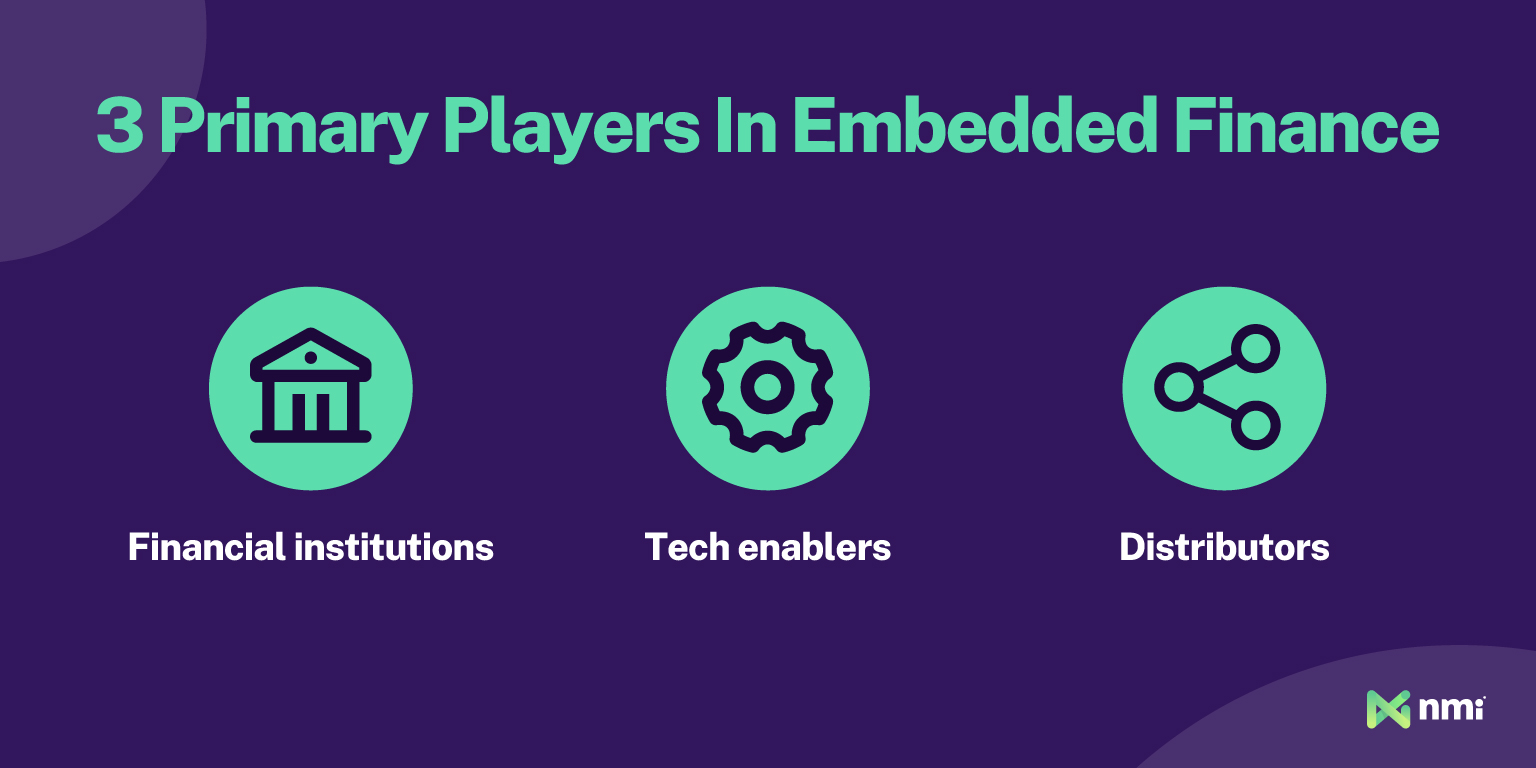
There are three primary types of players in embedded finance: financial institutions, tech enablers and distributors.
Financial institutions are the balance sheet providers. They’re the banks that offer the financial products underpinning the whole system. They hold the licenses and the accounts, and they manage the lion’s share of the risk and compliance.
Tech enablers are platforms that make and maintain the connections that allow embedded finance to work. They build, document and manage the application program interfaces (APIs) and provide technical support so that the other players can plug in to EmFi quickly and easily.
SaaS companies act as distributors — the front-line of embedded finance. They own the customer relationship and provide the front-end interface, which connects to a financial institution through a tech enabler.
The Value SaaS Companies Bring to Embedded Finance
SaaS companies provide value in two directions. First, they offer their users faster, easier access to financial products, when and where they’re needed.
SaaS companies also provide a lot of value to their upstream EmFi partners because they offer reach. Embedded finance is a huge opportunity for financial institutions because it allows them to tap into the existing user base of distributors at very low cost. The SaaS company gets a new product to offer and a new source of revenue, and the bank gets access to the users it would likely never reach otherwise.
This win-win relationship is one of the reasons embedded finance is spreading through the SaaS world so rapidly, and why it will soon become table stakes for business software.
Common and Emerging Embedded Finance Use Cases in B2B SaaS
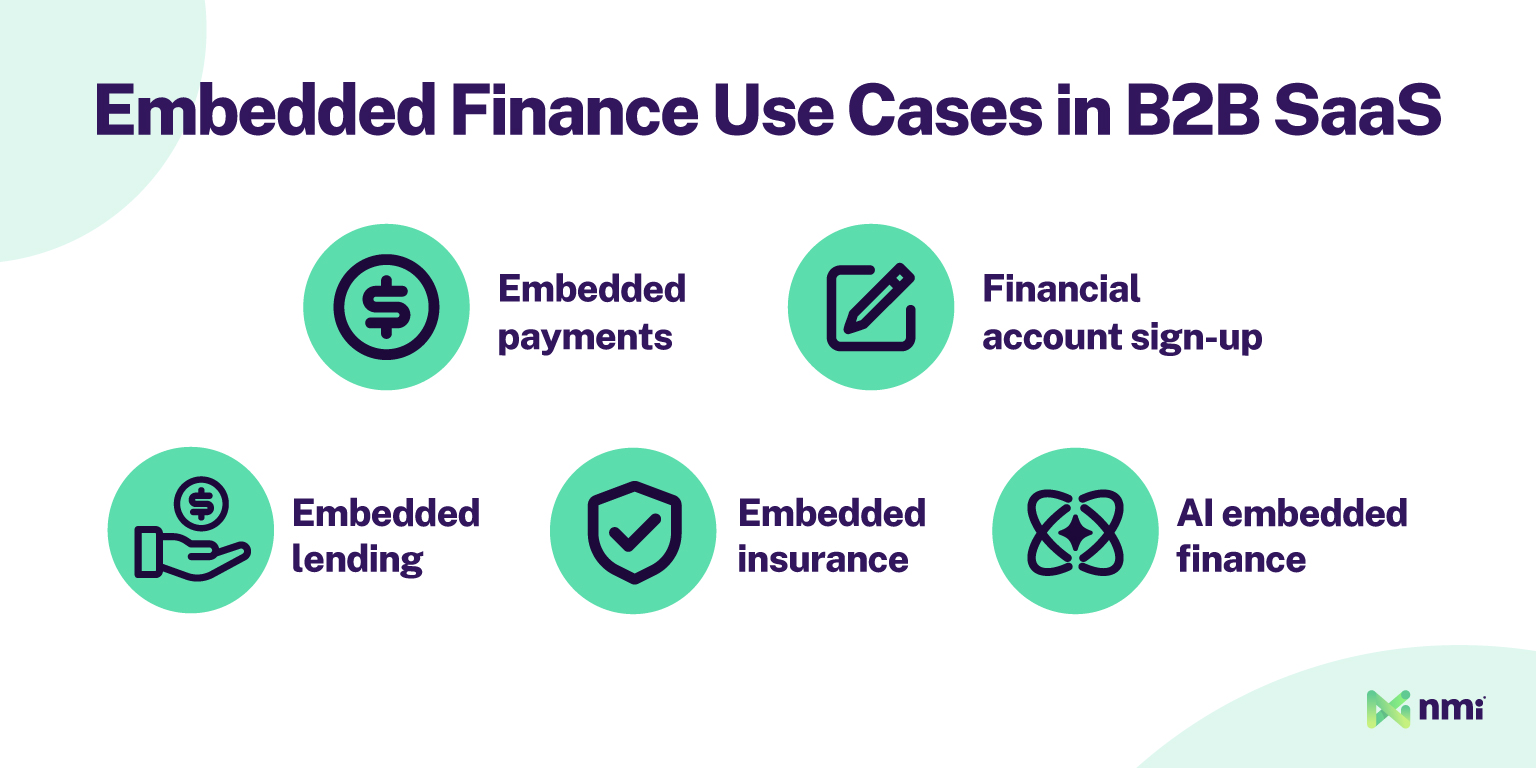
There is a long list of embedded finance use cases. Some of the most prominent and rapidly growing include embedded payments, deposit accounts, embedded lending and embedded insurance.
Embedded Payments
Payments were one of the earliest fintech use cases that software companies adopted. Initially, this just meant integrating the ability to accept payments directly into niche software platforms. But today, business SaaS users are increasingly getting their payment processing and merchant services directly from their software providers, through embedded payment acceptance platforms like NMI. This is the next evolution of embedded payments, and it’s accelerating rapidly.
Financial Account Sign-Up
Some software companies have partnered with banks to allow users to sign up for deposit accounts, manage money and even order debit cards through platforms like QuickBooks Checking. In-software credit card applications are also becoming more common, adding an issuing layer on top of account sign-up.
Embedded Lending
Embedded lending allows users to apply for and receive loans directly through a software platform. The user can quickly fill out an application, and the lender on the other end can use the rich data generated by the SaaS platform to make a better assessment of creditworthiness.
For example, Amazon Lending lets third-party sellers access capital for their business needs, and Amazon can factor selling history into loan decisions to ensure profitability. In consumer ecommerce, embedded lending is already extremely common. But, it’s starting to ramp up in the business-to-business (B2B) world, and it’s changing the way small businesses access capital.
Embedded Insurance
In the consumer world, embedded insurance makes it easy to bundle policies with online purchases, such as travel insurance, extended warranties and more. In the B2B world, it allows businesses to access more tailored policies as part of their regular daily workflows. That not only reduces friction but also helps optimize policies by utilizing the rich data that can be shared between SaaS providers and insurance providers. It also gives businesses easy access to flexible, short-term insurance for as-needed applications like a restaurant licensing a temporary patio.
AI Embedded Finance Enhancements
The sea of user data generated by SaaS platforms is a big part of what makes embedded finance work so well. And that makes EmFi an ideal application for artificial intelligence. AI is already being employed to help institutions on the banking side process user data for better decisions. But, in the near future, the big game changer will be the integration of EmFi agents that enable conversational banking, allowing business owners to manage money and access financial services within software platforms as if they were speaking directly to an advisor.
How Embedded Finance Benefits SaaS Providers
Competitive Advantage
For end users, the big value proposition of EmFi is fast access. For example, getting access to affordable capital has long been a struggle for small and medium-sized businesses. 81% say it’s difficult to get a loan, and over half say they can’t afford the loans they’re approved for. So, a SaaS provider who can also offer faster, easier access to affordable capital has a huge leg up on competitors who can’t. That applies to all aspects of EmFi, including payments and insurance.
New, Low-Friction Revenue Channels
EmFi represents a low-friction source of new revenue. SaaS providers can capture a slice of the pie on everything — transaction processing, loan issuing, policy writing, and more — all while the financial institutions behind the curtain take on almost all the financial risk. And, while the SaaS provider isn’t completely free of compliance burden, the banks and tech enablers shoulder the vast majority of that.
Plug-and-Play Market Access
Embedded finance partnerships are designed to allow each participant to do what they do best. Through self-serve options and easy-to-use APIs, banks and tech enablers make it as simple as possible for distributors to plug embedded finance products into their software. That means SaaS providers can gain turnkey access to new products and markets without having to undergo any significant development or hire new in-house experts.
The Future of Business Software Is Embedded
In a world where almost everyone is seeking more frictionless digital experiences, it makes no sense to ignore embedded finance. In the future, software companies will see embedded payments, lending and insurance as features that every user expects.
But, today, they represent significant competitive advantages. The SaaS companies that get a head start on these integrations will benefit most as EmFi changes the way businesses and consumers access banking and finance.
NMI Payments offers SaaS providers fast, flexible and full-service access to embedded payments. It enables frictionless monetization of in-software transactions, which opens up new revenue channels while boosting value to users. To find out how easy it is to offer payments directly to your users, click here to take our new self-serve portal for a test drive.