



Banking is a competitive industry. For smaller banks to keep up with national giants, they need to do two things: First, offer customers services that are wider in scope and higher quality than the competition. And second, open up new sources of non-deposit and non-interest revenue to diversify revenue.
Those two things make payment processing and merchant services a slam dunk for most small banks. However, many banks aren’t optimizing their revenue from merchant services, if they even offer them at all. Between the complexity of the industry and competition from disruptive fintechs, big-name payment platforms, and national banks, it’s a tough business to crack.
So, how can smaller banking players draw merchants away from well-established competitors that have deep pockets, name recognition and sophisticated technology driving their payment operations? The answer is payments-specific customer relationship management (CRM) software — a turnkey way to access the same sophisticated tech the big guys use, without the need to build, maintain or manage it in-house.
Let’s take a look at why modular payments CRMs are such a powerful option for banks, the critical tasks and processes they automate and enhance, and how easy it can be to start using one to gain a powerful competitive advantage.
Why Payments-Specific CRM Modules Make a Difference for Banks
CRM software is table stakes in effectively every industry, and with good reason: It streamlines sales processes and improves customer relationships. As a result, every bank already uses some form of CRM. And most of them do the exact same things; they track leads, store customer data and automate certain sales and support processes.
That’s more than enough in generic sales environments. But payments is not a generic sales environment.
Payments is an extremely unique, complex and highly-competitive industry, and the reality is that the data and tasks payments providers need to handle, not just well, but perfectly, go way beyond the capabilities of generic CRMs. So, what’s the solution?
Payments-specific CRMs with modular capabilities take all the sales and support features of big-box solutions like Salesforce or HubSpot, and add systems designed to handle the most complex aspects of the payments business — not as bolted-on extensions, but as fully-integrated features, designed to work together seamlessly right out of the box.
These features include: onboarding, residuals management, reporting and process unification.
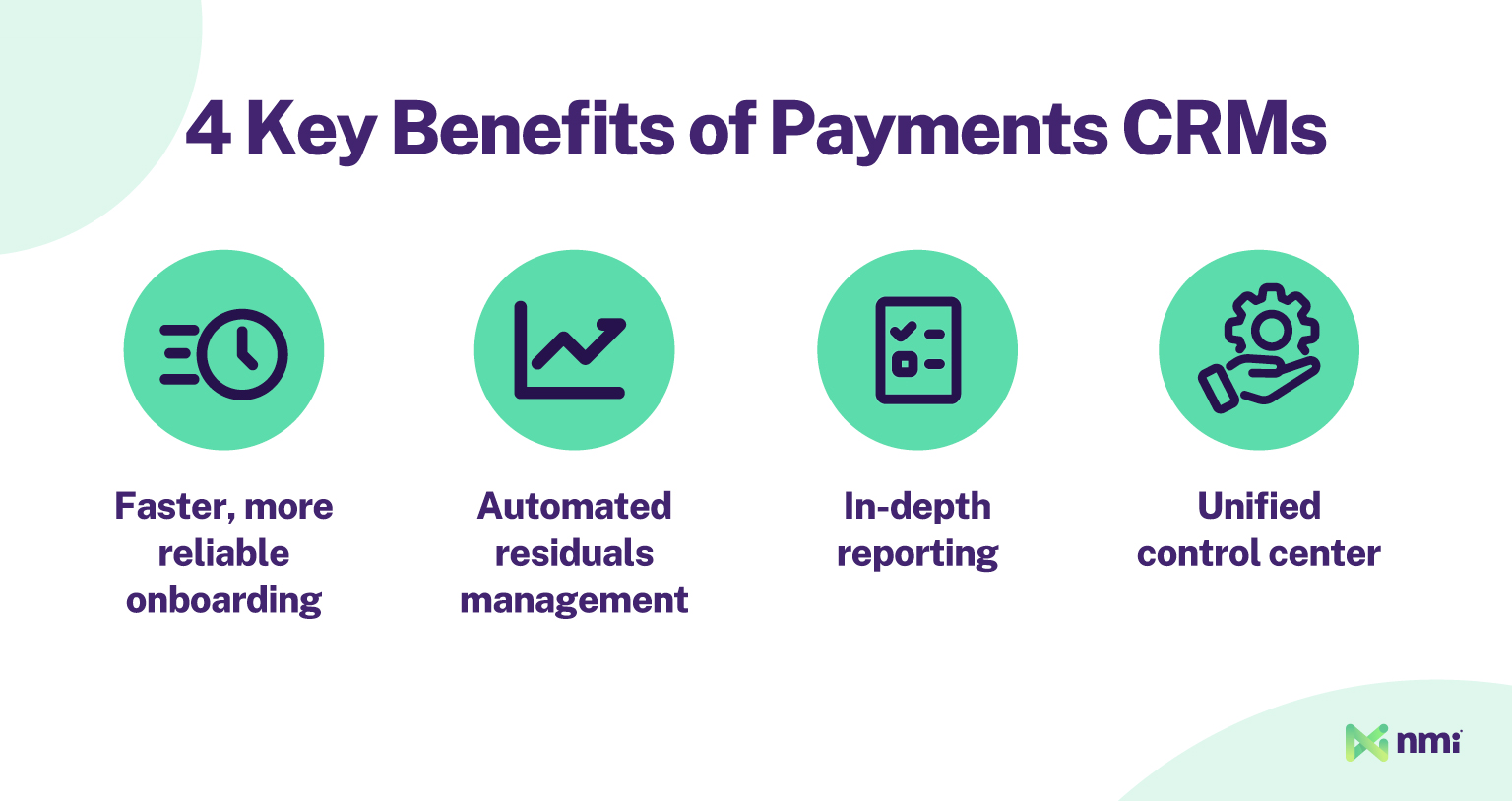
Onboarding:
A modular, payments-centric CRM with automated onboarding capabilities streamlines and enhances the onboarding process by eliminating the need for employees to manually transfer data from processing applications into the partner’s boarding portal. That accomplishes two big things:
- It eliminates human errors that can delay or even tank a merchant’s application
- It eliminates most of the work from onboarding, enabling banks to process and submit applications in as little as five minutes or less
Faster, more accurate onboarding maximizes approval rates, eliminates bottlenecks and enables the merchant to sign up and start processing payments quickly. All three are critical for staying competitive and maximizing revenue from payments.
Residuals Management:
How residuals are tracked and managed impacts on payment operations. First, it isn’t uncommon for payment providers to spend dozens of hours per month wrangling residuals data. Residuals management also affects relationships with sales agents. Errors or delays in their payouts can sour relationships in a space where top talent is highly portable and in short supply.
The right modular payments CRM platform offers your bank an advanced residuals dashboard that can automatically combine and process reports from all residual sources. That means accurate data is automatically available as soon as numbers drop each month, with no need to sift through reports or manually calculate anything. In addition, agents or other stakeholders can be granted secure access to the dashboard to view their residual statements and detailed breakdowns as soon as processing is complete—an added layer of transparency and value. The end result is huge savings in time and resources, and lightning-fast, laser-accurate payouts to any agents or stakeholders.
Reporting:
Like all areas of banking and finance, payments is a data-heavy game, and the ability to capture and use as much merchant data as possible is a strategic and competitive imperative. Banks that attempt to capture and manage merchant data through existing, unoptimized systems will struggle to extract maximum value, while those that opt to build payments-centric reporting in-house face technical and cost challenges.
A payments CRM solves the data problem by making advanced, purpose-built payments reporting a turnkey feature. Built-in reporting ensures your bank always has the deepest possible insights into how your merchants are performing, both historically and in real-time. The result is better financial management, better projections, better decision-making and better, proactive merchant support.
Unification:
Most providers treat sales and support, onboarding, residuals management and reporting as distinct processes. But, with a payments CRM, your bank gains the ability to tackle each workflow holistically, through a single, unified control center. That not only saves a ton of time, it also allows the data from each pillar of payment processing to feed and support the others.
For example, the data from onboarding supports automated residual split calculations while data from reporting supports the sales team in upselling and cross-selling new services.
No aspect of payments exists in isolation, and only with a purpose-built CRM can your bank approach payment processing as a fully unified business. That provides a huge competitive advantage over other banks and providers still doing things the old way.
What NMI Merchant Central Brings to the Table
Merchant Central is NMI’s flagship CRM system. Unlike the competition, it was designed specifically with payments in mind from day one, which makes it both the most complete and the most user-friendly payments CRM solution available today.
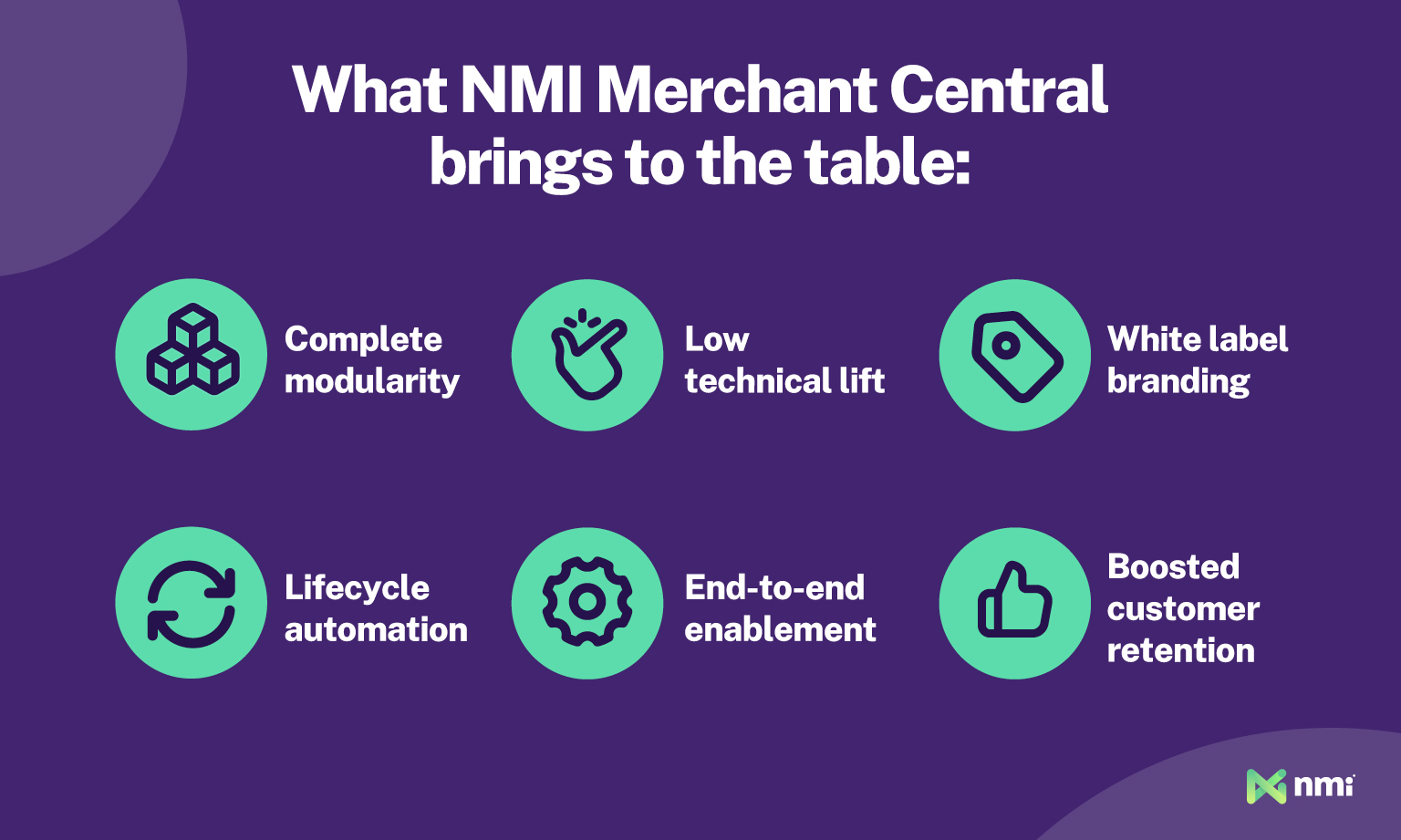
Just some of the benefits it offers include:
Complete Modularity:
One of the core value propositions of Merchant Central, and the entire NMI ecosystem, is modularity. The CRM can be used as a whole, or each part can be integrated into your bank’s tech stack separately, offering you the ultimate in flexibility, scalability and cost control. Take what you need, when you need it, and add or subtract as your business requires — only Merchant Central offers that level of choice and control.
Low Technical Lift:
Merchant Central is a plug-and-play system that enables you to seamlessly blend it into your tech stack with low-code integrations. That ensures you can enjoy all the benefits of a payments CRM without the need for deep, in-house technical expertise or the costs and headaches of expensive custom development. If you do have the in-house dev team and the knowledge, or grow into it over time, Merchant Central’s developer-friendly API also allows you to customize your integration if and when needed.
White Label Branding:
Banking is all about trust. That means your merchants need to know they’re working with you, not some third-party company they’ve never heard of. For that reason, Merchant Central offers complete white label customization. Whether you’re integrating individual modules or the entire system, everything is skinned with your branding. That means when a merchant signs up for payments, submits a support request or accesses their reporting, your bank’s identity will be front and center, building the relationship and fostering trust.
Lifecycle Automation:
Merchant Central enhances and automates all areas of the merchant lifecycle, from initial prospecting to signup to ongoing processing for the life of the account. Sales, onboarding, residuals, reporting and ongoing support, all in a single, user-friendly platform — that’s the advantage Merchant Central offers over all other options.
End-to-End Enablement:
Merchant Central is a true end-to-end solution. That means your bank can use it to enable payments even if you don’t have existing payment processing or relationships with sponsor banks. Merchant Central integrates seamlessly with NMI Payments, offering a turnkey underwriting and processing with generous revenue-sharing and residual options. That makes Merchant Central a one-stop path into the payments business, as well as a data and process enabler.
Boosted Customer Retention:
Merchants like to get payment processing through their bank thanks to the strong, high-trust relationship that already exists. But they have no shortage of other options, so trust alone isn’t enough. You also need to offer service that meets or exceeds their expectations.
Merchant Central makes it possible for your bank to offer the fast signup and onboarding merchants expect from providers like Stripe, with a level of personal touch and white-glove support the big platforms can’t touch. That deepens your integration with your customers, increases trust and makes you a more critical part of their success. All that equals stickier relationships and better retention.
If you’re ready to find out more about how easy it is to integrate Merchant Central into your payment operations, reach out to a member of our team today. Or, if you’d like to get a first hand look at how easy it is to use, explore Merchant Central’s payments CRM on your own with our virtual demo.