


In payments, compliance has traditionally been treated as a safeguard. A necessary layer of checks to manage risk, satisfy regulators and protect against fraud. But that view is starting to shift. For wholesale ISOs and PayFacs in particular, compliance is no longer just about risk mitigation, it’s becoming a defining factor in how quickly a business can grow, how efficiently it can operate and how competitive it is in the market.
At the centre of that shift is underwriting, the process of assessing and approving merchants. It’s one of the few areas that directly influences risk exposure, speed to revenue and the overall merchant experience. And increasingly, it’s where the gap is widening between providers that can scale and those that can’t. The difference comes down to one thing: automation.
In this article, we’ll look at why modernizing underwriting with automated, data-driven systems is key to reducing fraud, improving performance and supporting scalable growth.
Why Manual Compliance Doesn’t Scale
For years, compliance has been built around manual, high-touch workflows and legacy systems. Underwriters review applications, gather information, apply checks and make decisions. At lower volumes, that model holds up. But, payments businesses aren’t operating at low volumes anymore. As the number of merchant applications increase and expectations around onboarding speed rise manual processes begin to show their limits:
- Time is spent in the wrong places: skilled underwriters spend too much time chasing down basic information instead of focusing on complex risk decisions. The skill that makes them valuable in the first place.
- Bottlenecks become inevitable: as volume grows, applications back up and time-to-revenue on each new merchant stretches out.
- Consistency becomes harder to maintain: under pressure to maintain throughput and keep things moving, corners get cut. Approval rates may rise, but checks can be missed or applied inconsistently.
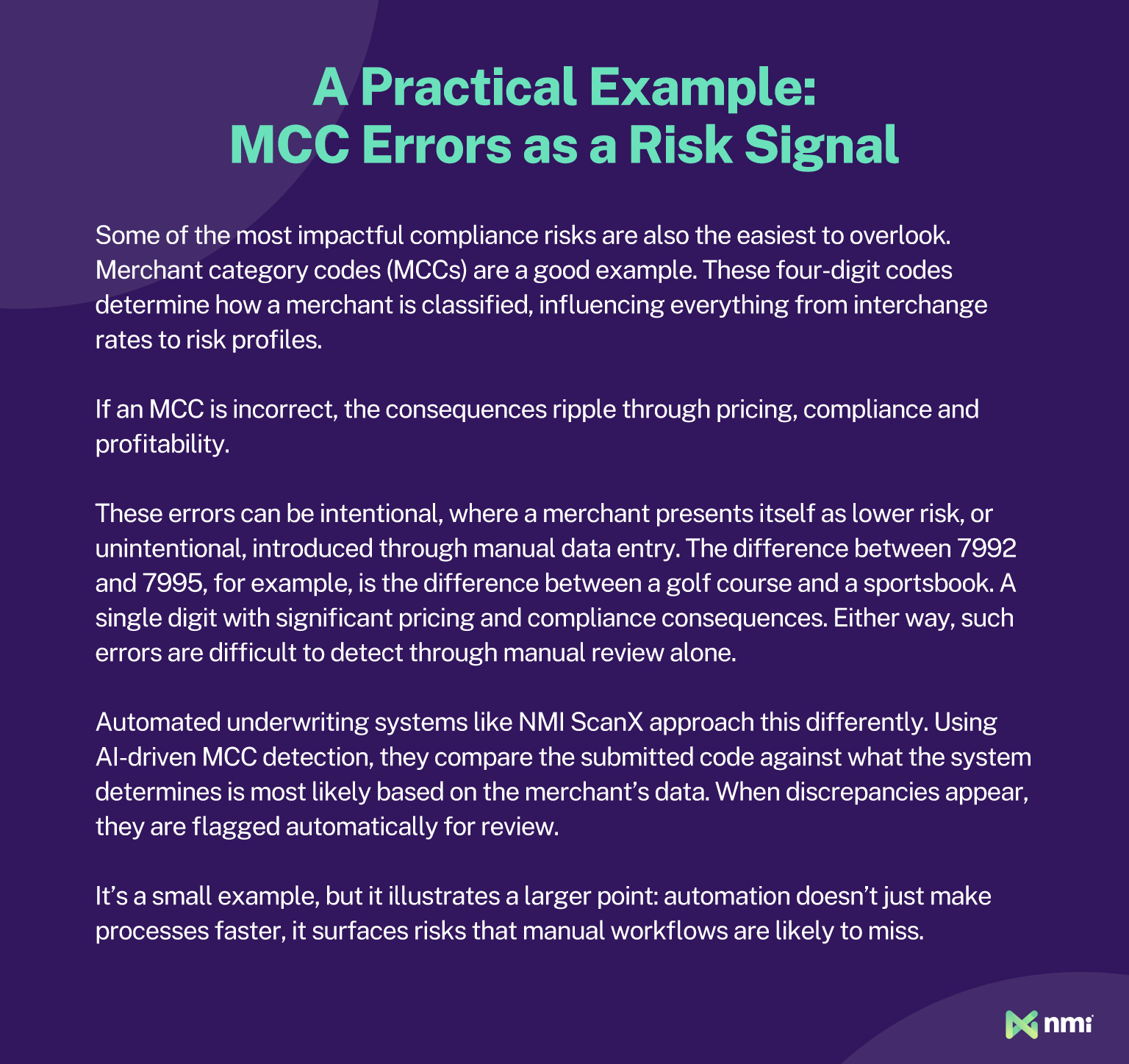
- Human error increases: small mistakes, like incorrect MCC codes, which can easily be mistyped, can have outsized financial and compliance impacts. When teams are struggling to manage volume, these kinds of errors become more frequent.
At a certain point, the issue isn’t efficiency, it’s structural. Manual compliance simply wasn’t designed for the scale and speed the industry now demands.
The Hidden Cost of Human-Dependent Workflows
Underwriters play a critical role in compliance. But when processes depend entirely on manual effort from start to finish, the costs add up quickly.
The Cost of Delayed Time-to-Revenue
Research from The Strawhecker Group shows it takes an average of 19 days to activate a merchant, and that number climbs based on processing volume. For merchants processing over $50 million in annual volume, activation takes an average of 59 days.
At that level, a two-month delay in processing represents more than $8 million in delayed transaction volume as well as the revenue from residuals that it would generate. Every day of delay is also a day when the merchant might reconsider and decide to go elsewhere.
The Cost of a Poor Onboarding Experience
As of 2024, 70% of banks lose customers due to inefficient KYC and onboarding processes. Delays, complexity and poor customer experience are among the top reasons cited. With platforms like PayPal and Stripe offering near-instant time-to-processing, any friction in the onboarding journey risks driving merchants to a competitor that can get them up and running faster.
The Cost of Scaling Through People Alone
In manual environments, everyday factors like a vacation, illness or staff turnover can cause significant disruption to workflows. Scaling through headcount is also expensive with senior underwriters in the US earning around $100,000 on average.
Taken together, these challenges point to a broader reality: human-dependent compliance doesn’t just limit efficiency, it limits growth.
How Automation Changes the Equation
Automation is often positioned as a way to improve efficiency. In underwriting, its impact is broader than that. It fundamentally changes how compliance operates, removing the traditional trade-offs between speed, accuracy and scale.
Speed improves because routine work disappears
Automated compliance software handles the repetitive, rules-based work that computers are best suited for. That frees underwriters to focus on the complex edge cases that have the biggest impact on margins. It also allows the lowest-risk merchants to be processed and approved with little or no manual intervention, cutting review time from days to minutes, reducing merchant abandonment and improving the onboarding experience.
Accuracy improves through consistency
Automated systems apply checks consistently across every merchant application. This reduces human bias, allows more checks to be performed at speed and minimises errors that lead to rework or incorrect decisions. The result is more reliable and defensible outcomes.
Scale becomes built-in rather than bolted on
Automated systems don’t get tired, take breaks or go home at the end of the day. Adding a large volume of additional applications doesn’t slow throughput. Underwriting operations can scale with the business, without costly investments in additional technology or headcount.
The role of the underwriter doesn’t disappear. It evolves, shifting away from administrative work and toward higher-value risk assessment and exception handling.
Turning Compliance Into a Growth Lever
Automation transforms compliance from a cost center into a competitive advantage that actively supports growth. For payments companies operating in a fast-moving and fraud-prone environment, that translates into three tangible advantages:
- Better, more consistent risk management that clamps down on fraud and boosts profitability
- Faster, more frictionless onboarding experiences that start the merchant relationship off on the right foot
- Easier scaling as the business grows, without sacrificing quality or driving up costs
Looking ahead, the complexity of compliance will only increase. New payment models, evolving regulation and emerging concepts like agentic commerce will introduce new challenges and new fraud vectors.
In that environment, the question is no longer whether to automate compliance, but how quickly it can be done.
NMI ScanX, part of Merchant Central Payments CRM, is a fully automated underwriting system that performs 100+ customizable checks in minutes, enabling partners to process up to 10x more applications per underwriter. With built-in tools like Decision Report, Scorecard Insights and fully automated MCC detection, NMI ScanX supports more efficient, accurate and scalable compliance. To learn more about how NMI can support your compliance processes, reach out to a member of our team today.
