




“Credit card fees are too expensive for business transactions.”
That’s a commonly held view among business-to-business (B2B) suppliers, and it results in far lower card acceptance in the B2B world than in the business-to-consumer (B2C) world. Worse still, it’s driving a disconnect between suppliers, who want to minimize fees, and their customers, who want the convenience of card payments and the extra benefits they offer, like rewards programs
Thanks to Level 2 and Level 3 processing, though, commercial card payments don’t have to be too expensive. By collecting deeper transaction data to lower risk, these advanced data programs offer processors and merchants lower interchange fees, enabling B2B businesses to meet customers where they are — without sacrificing margins to high interchange costs
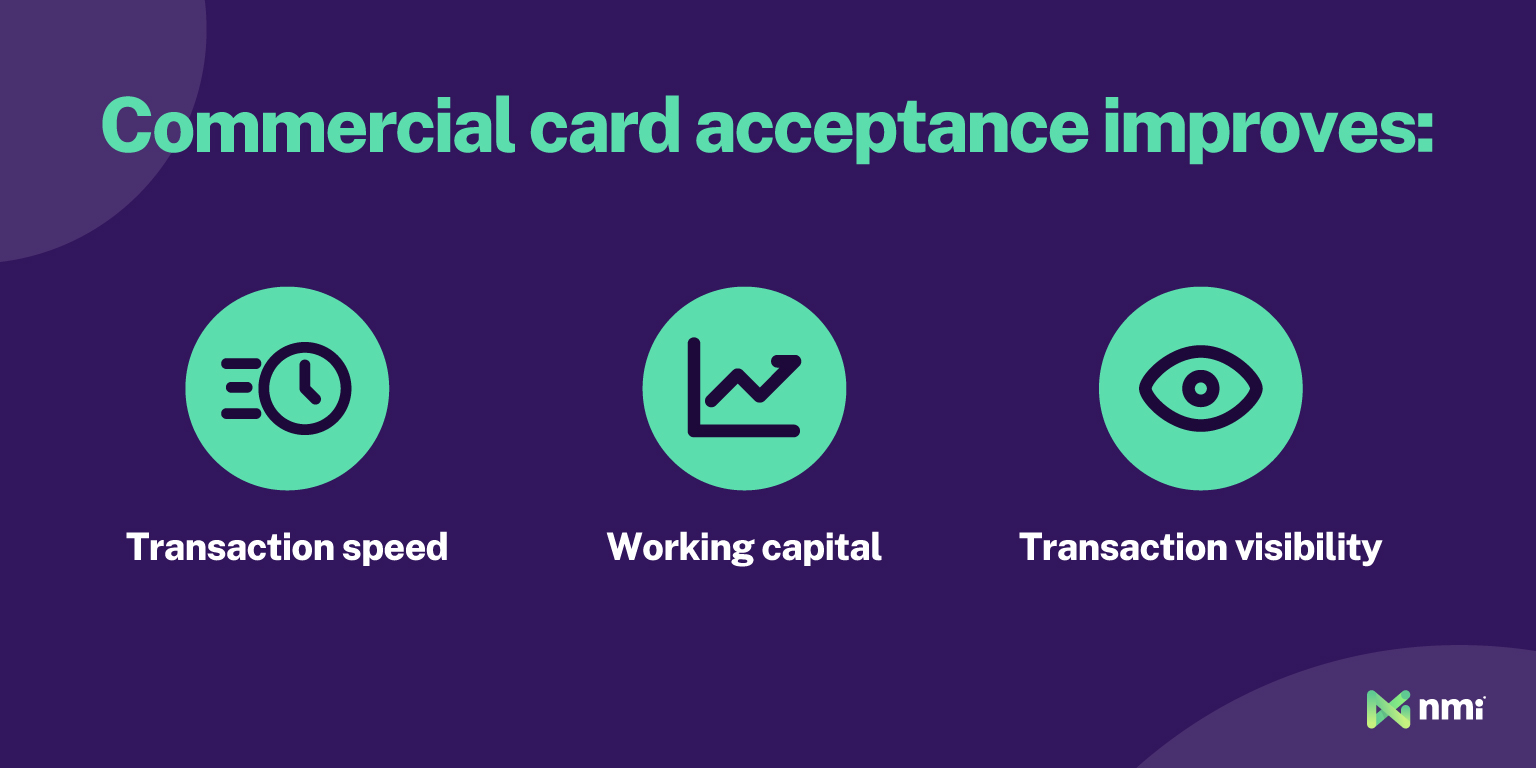
In this article, we’ll look at some of the challenges and perceptions that keep B2B sellers from adopting card payments. We’ll also discuss how Level 3 processing can ease their cost concerns and what benefits B2B sellers stand to unlock, like faster access to revenue, improved working capital and better transaction visibility.
The Disconnect Between Business Buyers and Business Sellers
Many B2B sellers are hesitant to accept commercial credit cards for payments, despite the fact that their buyers want to use them. Recent research from Mastercard found that:
- Two-thirds of B2B suppliers report regularly failing to meet their customers’ payment expectations
- 89% say they struggle to balance their customers’ payment preferences with their own operational needs
- 48% expect customers to ask to pay by card more often in the next five years
While B2B card acceptance is slowly becoming more common, payment methods like ACH, wire transfers and even paper checks are still dominant, especially for large transactions. For example, Mastercard found that 71% of suppliers in the manufacturing industry cite reliance on paper checks — a grossly outdated system — as their top B2B payments challenge.
The Cost Issue
The biggest reason B2B suppliers don’t like taking credit cards is the swipe fees. The U.S. has some of the highest swipe fees in the world, often ranging anywhere from 1.5% to as much as 4% of the total sale value. That’s a significant amount of money when applied to large sales such as inventory orders, capital expenditures and product manufacturing. And the pain is especially sharp for businesses operating on tight margins; for them, giving up a few percent on a sale could significantly impact profitability.
How Level 2 and Level 3 Processing Make Cards a More Affordable and Practical Choice for B2B
Credit card payments have a bad reputation among B2B suppliers for high costs, but they don’t have to be as expensive as most business owners think. Advanced processing with Level 2 and Level 3 card data can reduce interchange rates, making swipe fees lower and card payments more practical.
How Level 3 Processing Works
Level 2 and Level 3 data, which Visa now refers to as Product 3 under its new Commercial Enhanced Data Program (CEDP), is a set of extra data points that go beyond what is normally collected at the point of sale.
In addition to the standard data collected on every transaction, like purchase amounts and merchant name, Level 2 and Level 3 transactions also collect:
- Tax amount
- Tax ID
- Tax indicator
- Customer code/PO number
- Duty
- Commodity codes
- Product codes
- Item quantities
- Unit of measure
- Unit of cost
- Discount rates
- Discount per line item
- Line item total
- Shipping amount
- Destination zip and country codes
More data means tighter controls and a lower risk of fraud, which the card networks, like Visa and Mastercard, reward with lower interchange fees.
CEDP and Level 3 Fee Discounts
Under CEDP, Visa no longer offers a Level 2 program. Mastercard still does, but to unlock the best interchange rates, B2B merchants should always try to submit complete Level 3 data anyway. If high-quality CEDP or Level 3 data is submitted, interchange rates can fall by as much as 10%.
That discount still flows through the payment processor, who can choose how much of the savings they pass on to the merchant. But, processors want their B2B merchants to accept more card payments, so passing on the lion’s share of the interchange savings is in their best interests.
Swipe Fees vs. the Benefits of Commercial Card Acceptance
On its own, a Level 3 interchange reduction may not be enough to make card acceptance a slam dunk. But it could be enough to get B2B sellers to reconsider the practicality of commercial card payments when weighing the many other benefits they offer. Benefits like:
Transaction Speed: Mastercard found that slow transactions were the top B2B payment challenge for suppliers in tech and retail. Waiting for a check can take weeks. ACH payments can take three business days and sometimes even more to post. But with a credit card payment, B2B merchants can often access next-day or even same-day funding, giving them the fastest possible access to their revenue outside of a big bag of cash.
Improved Working Capital: Improvements in both timely payments and funding speed mean B2B suppliers who accept commercial card payments can manage their working capital better. Mastercard found that 71% of B2B sellers face working capital challenges. But card accepters are 14% more likely to say they can successfully maximize working capital, and 12% less likely to cite it as a challenge.
Improved Transaction Visibility: Manual payment processes are extremely inaccurate and often result in incorrectly recorded data and low-quality historical reporting. Credit card payments make data capture and transaction visibility more efficient and far more accurate. That makes it easy for B2B suppliers to understand their payments and use their transaction data to drive operational improvements.
Have the Level 3 Processing Conversation With Your B2B Merchants
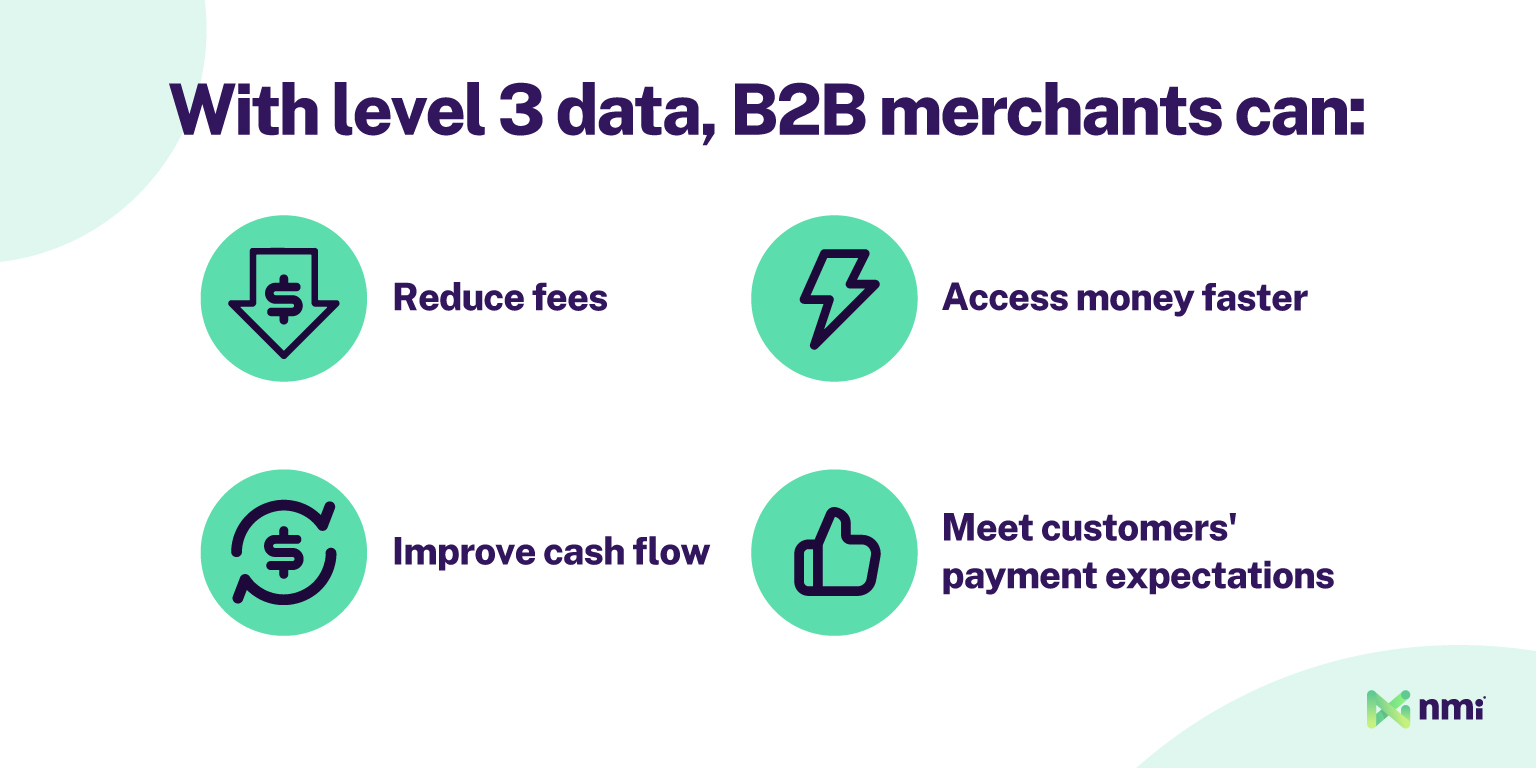
By unlocking interchange discounts, the cost-benefit equation shifts and commercial card acceptance becomes a much more appealing option. That makes Level 3 and CEDP a great value-added service to talk to B2B merchants about. By accepting cards and submitting Level 3 data, they can:
- Reduce fees
- Access money faster
- Improve cash flow
- Meet customers’ payment expectations
To help your merchants benefit from Level 3 transactions data, you’ll need a way to help them capture it. That’s where NMI Level III Advantage comes in.
Level III Advantage makes it easy to collect and submit complete, accurate enhanced data. It’s also fully CEDP-ready, ensuring your merchants can access improved interchange rates from both Visa and Mastercard.
To find out more about how NMI can help you capture more of your B2B merchants’ transactions, reach out to a member of our team.