


If you build and sell software, your buyer is about to change. Soon, you’ll need to be ready to sell to human users and autonomous AI agents acting on someone’s behalf, using a new way to pay: agentic micropayments. These new micropayments aren’t going to replace traditional online payment rails, but they are going to supplement them, as a new generation of highly capable AI models is now making autonomous agentic workflows practical and scalable in a way they never were before. That shift won’t just change how software is built. It will change how software is discovered, consumed and paid for, and that’s something SaaS companies need to start paying attention to now.
Much of the discussion around agentic commerce has focused on AI-powered shoppers buying groceries, booking travel or purchasing products on a consumer’s behalf. Those experiences are likely to develop, but they also require significant progress around trust, identity, consumer protection, fraud and liability.
There is another form of agentic commerce that may emerge much sooner: agents paying other digital services for extremely small pieces of work. An AI agent might pay a few cents to query a specialist database. Another might purchase a single piece of market intelligence, access additional compute capacity, verify an identity or call a highly specialized API. Individually, these transactions may be tiny. At machine scale, they could become an important new layer of the digital economy.
For B2B SaaS companies, that creates an interesting possibility. Micropayments aren’t going to replace traditional online payment rails, but they will supplement them, opening the door to new usage models, new competitors and entirely new categories of software product. As a result, it could have a number of future impacts on your business, including shifting demand, defining agentic discoverability and creating new opportunities for hyper-niche products.
The Emerging Role of Micropayments in Agentic Commerce
AI agents are becoming increasingly capable of completing complex workflows made up of many individual tasks. A business might ask an agent to research a market, identify potential customers and produce a report. To do that, the agent could need access to dozens of external services: databases, analytics tools, verification services, research platforms, specialist models and other APIs.
Today, accessing those services usually requires a pre-existing commercial relationship. Someone needs to create an account, choose a subscription, negotiate usage limits or establish billing credentials. That model works when people are making purchasing decisions. It becomes much less practical when software is making thousands of decisions at machine speed.
Micropayments may turn out to be a practical and near-term use case for agentic payments. These tiny machine-to-machine payments could serve as the backbone for hierarchical agentic workflows, where agents subcontract other agents or access single-use tools to complete a task, often in a matter of seconds, before moving on to the next thing. The more agents there are working for your business, the more critical per-query transactions will become as a payments layer. If AI’s current trajectory holds, this kind of payments activity will scale.
What Are Agentic Micropayments?
Micropayments are extremely small transactions, often well below a dollar and potentially worth only fractions of a cent. The concept itself is not new. What is changing is the infrastructure available to make these payments economically viable at machine scale.
Micropayments use non-traditional channels like blockchains and HTTP protocol to instantly transfer money using the “HTTP 402 – Payment Required” code, which has been part of the internet since 1997, but never made practical sense because the fees on a card transaction cost more than most micropayments. But now, with agents able to orchestrate complex tasks at machine speeds and blockchains and other settlement technologies like real-time payments able to settle payments instantly at near-zero cost, micropayments are set to become a critical part of an AI-enabled future.
How Do Agentic Micropayments Work?
New protocols are currently being rolled out to facilitate micropayments at scale. The two leaders are x402, a protocol owned by the Linux Foundation and backed by almost a dozen big tech firms, and Machine Payments Protocol (MPP).
A typical agentic micropayment looks something like this:
- An AI agent calls an API to access a service
- The API responds with payment instructions, potentially using HTTP 402 – Payment Required code that tells the agent the price and how to pay
- The agent evaluates the cost against its instructions, budget and expected value.
- If it decides to proceed, payment credentials are exchanged programmatically.
- The agent accesses the service, completes the task and moves on.
There may be no checkout page, manually entered card details or traditional purchasing journey. The interaction takes place entirely between machines.
Exactly how those transactions are funded and settled will vary. Some emerging protocols use stablecoins and blockchain networks, while others are being designed to work alongside existing fiat and card payment infrastructure.
That distinction matters. Agentic payments are unlikely to depend on a single payment method or rail. The bigger change is that payment itself becomes something software can negotiate and execute automatically.
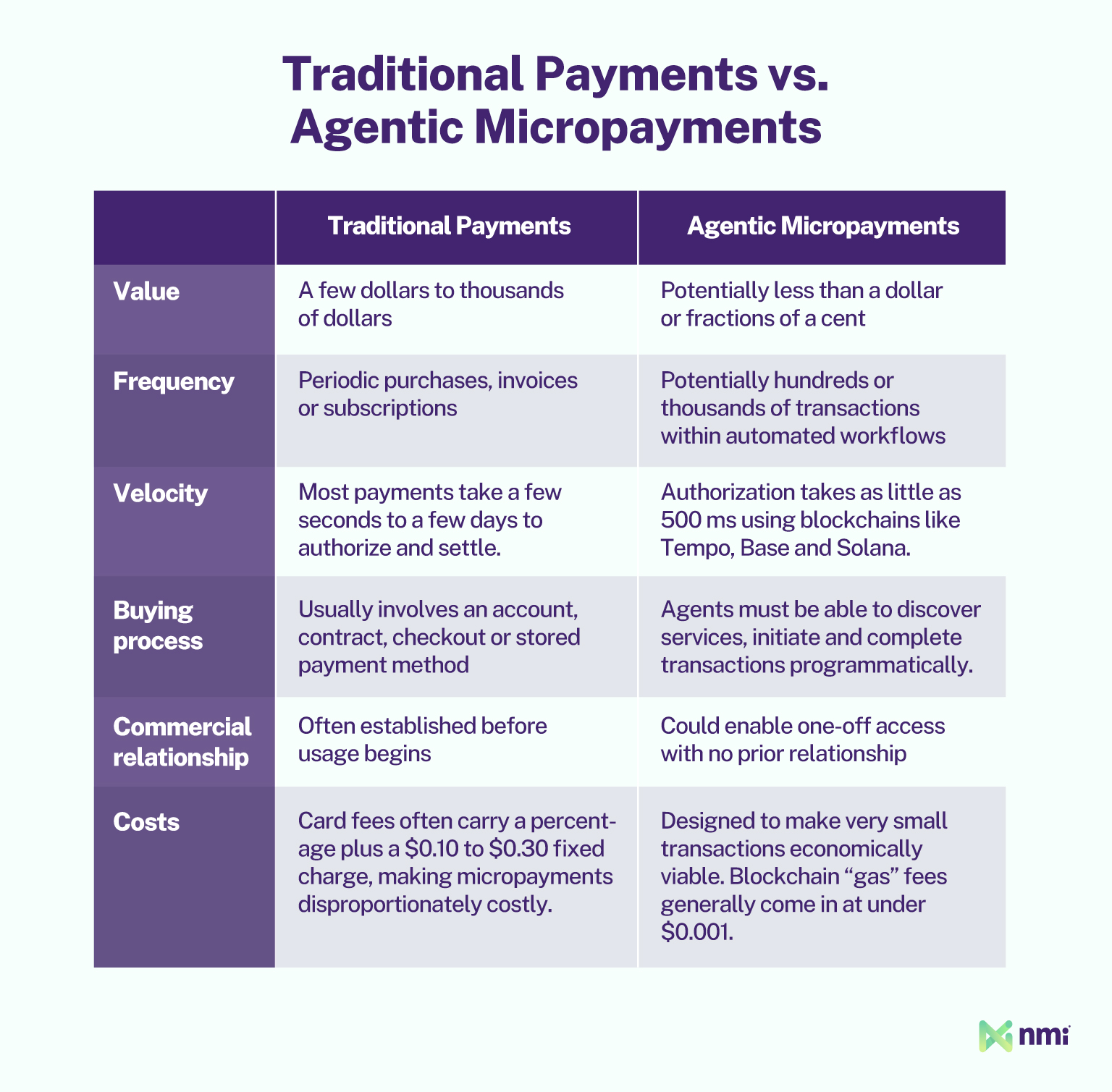
These characteristics could make micropayments particularly well suited to software environments where agents continuously discover, evaluate and use digital services.
Why Agentic Micropayments Matter to SaaS
Some Usage Will Shift from Subscriptions to Per-Query Usage
In the future, more companies will use agents to access services like data, social or customer intelligence, research and analysis tools, compute and more. These companies will increasingly look to move away from subscriptions in favor of per-query usage.
If a vendor requires a pre-existing subscription or a pre-negotiated metered billing plan, that slows agents down, limits their utility and makes it harder for them to sub-contract other agents. The more agentic workflows become the norm, the more they will need ways to work and pay on a per-query basis that can start and end with even just a single session.
A Shifting Landscape Could Make Micropayments a Competitive Necessity
When apps and app stores became mainstream, they opened up the software world to an army of insurgent new competitors. Micropayments could do the same thing, but specifically targeting an agent-centric user market.
HTTP 402 payments don’t require merchant accounts or traditional payments infrastructure like checkouts or gateways. A good developer can add micropayments to a tool in a few hours, and this lowers barriers to entry. With micropayments, even individual developers can roll out niche micro-tools that can be quickly monetized without the complexity of a traditional SaaS business.
In a world in which agents can search and evaluate hundreds or thousands of these microservices in seconds, being unable to serve per-query usage takes you out of contention for those agentic use sessions and any revenue they would’ve generated. You become undiscoverable to that new agentic market and a subscription-only model becomes a fence that turns agents away.
New Products Will Emerge That Only Make Sense Per Query
One of the most interesting possibilities of agentic micropayments isn’t disruption of subscriptions, but the opportunity to introduce new services that only make sense on a per-query basis.
Think of small tasks that are valuable to a buyer in the moment, but offer no path to an ongoing relationship or deeper lifetime value. Maybe a user needs access to some obscure piece of “exhaust data,” the byproduct data that all companies generate oceans of but can’t normally use or sell because it’s too long-tail. It has never been practical to acquire and onboard customers for that data as a product, but with micropayments, there is near-zero cost to opening up access and monetizing it. There is no shortage of opportunities for innovative SaaS companies to find this kind of fragmented edge revenue.
The Market Is Early, but It Is Moving
Agentic micropayments remain an emerging technology. Research from Visa and Artemis into early activity on x402 illustrates just how early. In its first year, millions of dollars flowed through the protocol across a large number of very small transactions, but activity was concentrated among a relatively small group of highly active users.
That is hardly evidence that micropayments are about to overturn the SaaS business model. But it does demonstrate something important: machines are already beginning to transact with other machines at a meaningful scale. At the same time, some of the largest companies in technology, payments and digital assets are investing in the infrastructure needed to make agentic payments possible.
SaaS Companies Should Start Asking a Different Question
There is no reason for SaaS companies to abandon subscriptions or rush to implement micropayments tomorrow. The market is too early for that. But there is a useful question product and payments teams can start asking now:
If an AI agent discovered our product today, could it understand what we offer, access the capability it needs, pay for just that capability and move on without human intervention?
For most SaaS businesses, the answer is probably no. Over time, that will increasingly matter.
Twenty years ago, software companies had to rethink their products for the smartphone-based app market. More recently, APIs transformed how software platforms connected with one another. Agentic computing is driving another transition, one in which software is not only used by machines but increasingly purchased by them too. In this next era, having the best software will not be enough. The winners will make their software easy for agents to discover, access and pay for.