

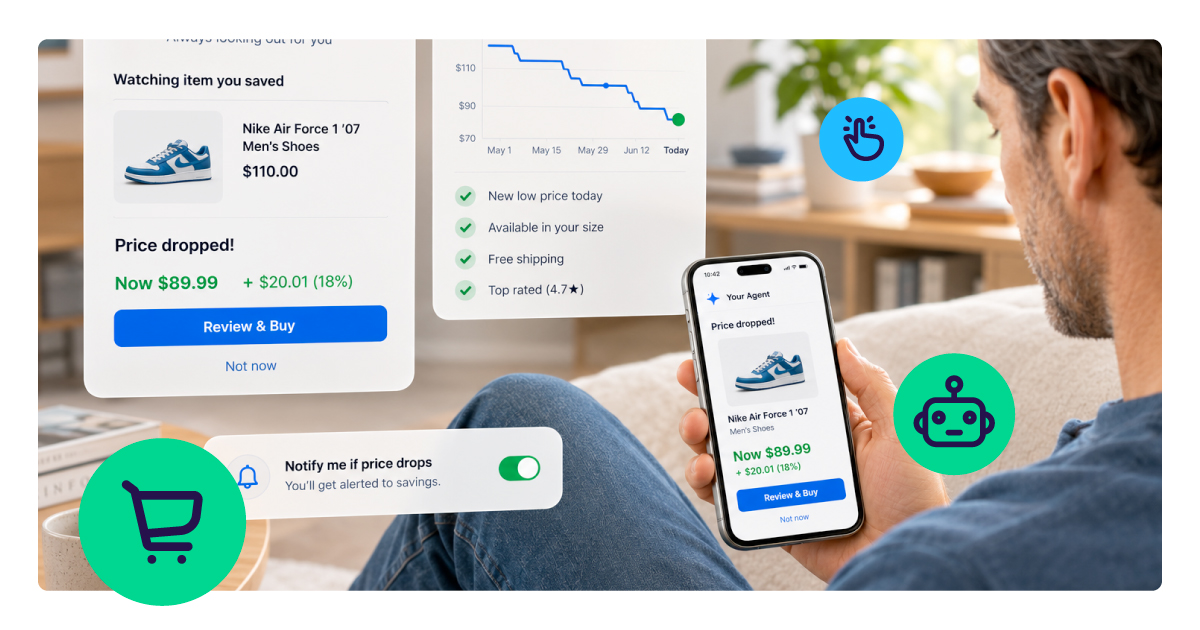
It’s difficult to talk about commerce right now without talking about AI agents. The vision is compelling: tell an AI what you need, give it a budget and let it do the rest. It searches, compares, chooses and pays. What once took multiple searches, browser tabs and checkout screens becomes a conversation.
There’s plenty of evidence that the way we shop is already changing. In July 2026, Salesforce reported that consumers using AI assistants as the first step in the shopping journey grew 200% year over year. But there’s an important distinction between starting a shopping journey with AI and letting AI finish it.
Our new research, surveying 1,000 adults in the United States, found that just 11% have used AI at the transaction stage, completing a transaction through an AI interface. But that is very different from handing over the entire shopping journey. Just 3% describe AI as a personal shopper that manages every stage for them, while 10% say they would currently be comfortable giving AI full control over a particular purchase. That gap is the real story of agentic commerce today: adoption is running well ahead of authorization.
Consumers aren’t rejecting AI. Far from it. They’re growing comfortable with AI as an assistant, researcher, deal finder and increasingly as a shopping companion. What they haven’t embraced is AI as an autonomous buyer.
And the closer AI gets to their money, the more cautious they become. That distinction matters, it shapes what your merchants will need to support, and how soon.
Consumers Are Saying Yes to Help, but Not Yet to Autonomy
One of the most interesting findings from our research wasn’t simply how much people use AI, but the very different roles they’re already giving it. For 39% of Americans, AI is still essentially a better search engine, a more powerful way to find information. More than half, 53%, used AI for research or information searches in the past month, making it the most common use by far.
For others, the relationship is already more personal. For 12%, AI is a lifestyle assistant that helps them plan vacations, decorate their homes, build routines and make everyday decisions. Another 8% describe it almost as a dependable friend, somewhere to go for a quick gut check, advice or reassurance.
Then there’s the other end of the spectrum. More than a quarter of consumers, 26%, still see AI as a futuristic stranger, a technology they’ve heard plenty about but aren’t yet comfortable using.
What’s striking is where shopping sits among all of this. Consumers already use AI to discover products, compare options and find value, and one-third used it for shopping or product discovery in the past month. Yet just 3% describe AI as a personal shopper they’d trust to manage every stage of the journey.
That’s the gap between using AI to shop and trusting AI to buy, and it explains why agentic commerce is developing differently from some of the more ambitious predictions. Consumers are deciding, task by task, how much responsibility to hand over:
- Find the best running shoes for a particular budget? Great
- Compare reviews and narrow ten options down to three? Useful
- Automatically find a discount code at checkout? Nearly two-thirds, 63%, say yes
Choose the shoes, decide how to pay and place the order without asking? That’s where enthusiasm evaporates
There’s a real difference between asking AI to find a pair of shoes and letting it buy them. The industry sometimes jumps too quickly from the first behavior to the second.
The Dividing Line Is Surprisingly Personal
Consumers are happy for AI to remove tedious steps. Nearly six in 10 (59%) are comfortable with AI recommending products, 58% would let it fill in a shipping address automatically and 56% support AI making checkout faster and more seamless.
Once AI starts making decisions that feel more personal, they pull back. Fifty eight percent are uncomfortable with AI deciding what clothing size to buy based on reviews and size guides. And notably for our industry, 55% don’t want AI recommending which payment method to use.
Selecting a payment method might look like a small step inside an automated shopping journey. To a consumer, it clearly isn’t.
A credit card, debit card, digital wallet or another option carries different implications for rewards, credit, cash flow, security and personal preference. Choosing how to pay is part of the purchase decision itself.
Convenience and control aren’t opposites. Consumers want both. And how much control they’re willing to give up may depend heavily on what they’re buying.
Not Every Purchase is Meant to be Automated
There’s another distinction that matters: sometimes we shop because we need something, and sometimes the choosing is part of the experience.
For everyday purchases, convenience can be the whole point. Reordering household essentials, paying a bill or replacing something you buy regularly are all moments where AI could feel genuinely useful. If you already know what you want, there may be little value in searching, comparing and checking out manually each time.
But plenty of shopping is more emotional than that. There’s a reason we talk about ‘retail therapy’. Finding a great deal can deliver a dopamine hit. Choosing the right birthday gift takes thought. And sometimes half the fun of splurging on a luxury item comes from browsing, comparing and finally saying ‘yes’, you’re going to treat yourself.
In those moments, reluctance to hand everything over to an AI agent may have little to do with security or technology. People won’t want to give up the part of the shopping experience they enjoy. That suggests agentic commerce won’t develop in the same way across every type of purchase. AI may become the buyer for the things we just want taken care of, while remaining an adviser, researcher or deal finder for purchases where the decision itself still matters. The opportunity isn’t necessarily to remove people from shopping. It’s to understand when they want AI to take over and when they still want to be part of the choice or the experience.
The Next Stage of Agentic Commerce Comes Down to Three Things
Looking across the research, three themes emerge repeatedly: trust, control and transparency.
Trust: Can I Trust AI With My Money?
This is the largest hurdle. Nearly seven in 10 consumers (69%) say they don’t trust AI to process payments securely, and 61% cite security or fraud among their concerns about AI completing purchases. Meanwhile, 84% have never uploaded payment details into an AI tool to enable it to buy something.
That last figure stands out. Consumers will happily share their preferences, ask increasingly personal questions and rely on AI recommendations, but payment credentials remain a boundary most haven’t crossed.
If something goes wrong, accountability spreads across the commerce ecosystem. If an AI bought something before a consumer was ready, 62% would blame the AI provider. But 34% would blame the retailer and 24% would blame the payments provider. That matters for you. As AI becomes another way to initiate commerce, consumers will expect the payment ecosystem to protect them, regardless of where the transaction began.
Control: Who Has the Final Say?
Consumers are clear that delegation shouldn’t mean surrender. Seven in 10 (70%) say it’s important that AI lets them review or override a decision before a purchase is made. Their concerns are practical: 60% worry an AI agent could spend more than they intended and 57% worry about losing control over purchases.
So the future isn’t a simple choice between manual commerce and fully autonomous commerce. There’s a much larger middle ground:
- Authorize an agent to spend up to $50, but require approval beyond that
- Allow recurring purchases of familiar products, but approve a new brand
- Let AI build a basket, but keep the final checkout button under human control
- Agentic commerce will develop through progressive delegation, not an overnight handover of control
Transparency: What Exactly Did I Authorize?
The third challenge is visibility. Half of consumers worry about limited insight into the decisions an AI agent makes, and 58% are concerned it could buy the wrong product, size, color or brand. That raises a bigger question: what does consent look like when the consumer is no longer directly initiating every action?
In a conventional checkout, the sequence is clear. A shopper chooses an item, selects a payment method and confirms the transaction. With an AI agent acting in between, that chain gets more complicated.
Did the consumer authorize this specific transaction? A category of purchases? A spending limit? A particular merchant? How long does that permission last, and when does the agent need to come back and ask again?
The card networks are already building answers. Scoped credentials that bind an agent to a specific merchant, spending limit and consent policy turn these questions into something the payment ecosystem can enforce rather than assume. They sound like infrastructure questions. They’re consumer trust questions.
Early Adopters Aren’t Asking for a Free-for-All Either
AI adoption will move quickly. Parents in our survey were particularly interesting: almost half of respondents with children at home, 48%, had already used AI for shopping or product discovery, compared with just 25% of respondents without children at home.
Millennials and Gen Z are enthusiastic too. Almost half of both generations say they’re excited about agentic commerce and believe it could make their lives easier.
Yet even among these groups, appetite for total autonomy is low. Only 16% of parents, 14% of Millennials and 13% of Gen Z would currently give AI full control over a purchase.
Early adopters aren’t saying “do whatever you want.” They’re saying “make this easier, but keep me in control.”
The Opportunity Is Bigger Than the Final Click
It’s tempting to judge the arrival of agentic commerce by how quickly consumers allow AI to make an entire purchase autonomously. That misses what’s already happening. AI is reshaping discovery, research, comparison and increasingly checkout, and consumers clearly see value in using it to remove friction from shopping.
The opportunity now is to build trust one step at a time. For our industry, that means thinking beyond whether an AI agent can initiate a transaction. We also need to establish what it was authorized to do, who authorized it, what limits were placed on that authority and when human approval is required. Adoption won’t happen evenly across every type of transaction. Consumers may readily delegate the repeat purchase of household essentials within a set budget, but keep much tighter control over a luxury item, a gift or something they simply enjoy choosing for themselves. The clearer the parameters and the less subjective the decision, the more natural a fit it becomes for agentic commerce.
The winners in agentic commerce won’t be the ones that remove the human from the shopping experience fastest. They’ll be the ones that give consumers enough confidence to decide when they’re ready to step out of the way.