

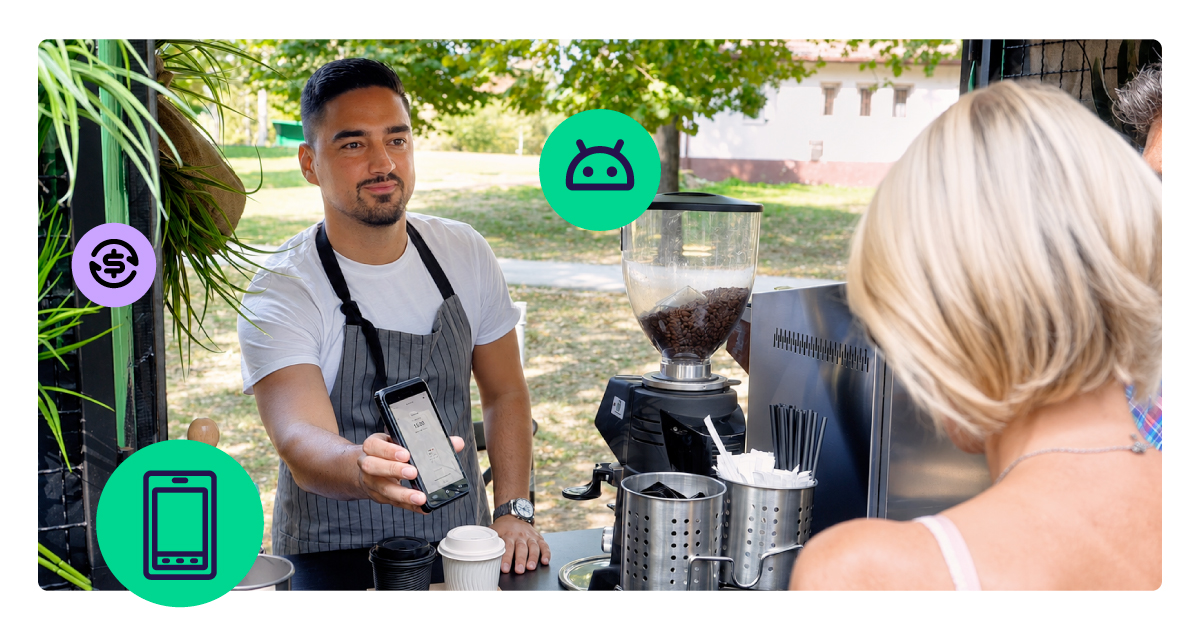
If your software serves users selling in the field or taking payments at a checkout counter or front desk, then you need to offer a variety of hardware solutions so their customers can pay in person with physical cards. But the right payment hardware should do more than accept a card. It should fit naturally into the workflow your software already supports.
Think about a field service technician collecting payment on a customer’s doorstep as soon as a job is complete. A restaurant server taking an order and payment tableside. A retail associate helping a customer check out from anywhere in the store. Or hotel staff taking payments away from the traditional front desk. In each case, the payment experience becomes part of the software experience, not a separate process bolted on.
But not all hardware is created equal, and the type you select has a big impact on both the user experience and your development journey as an embedded payments provider.
We all know the ubiquitous black payment pad with a tiny low-resolution screen. But that’s no longer your only option. Today, Android smart point-of-sale (POS) devices represent a new class of payment hardware that combines the familiarity and flexibility of Android software with purpose-built payments hardware. The result is a device that gives you the ability to build apps and deploy payments with more flexibility and less development friction, and gives your users a payments experience they already feel at home with.
Your Users Need In-Person Payment Solutions, But Traditional Hardware Offers Outdated UX
Most traditional payments hardware feels outdated because, for the most part, it is. Bulky cases, tiny screens, no touch functionality. It’s all very BlackBerry. But the biggest problem is that traditional hardware isn’t intuitive to use. Setup, navigating configuration menus and troubleshooting issues are all slow processes that require specialized knowledge. That means there’s a learning curve for the user, and when things go wrong, what could be a quick fix requires a support call. For a SaaS company, that isn’t just an inconvenience for the client, it can mean more onboarding friction, more support tickets and more time spent helping users operate hardware that sits outside the core software experience. In a modern payments environment where users expect frictionless experiences, there is no room for any of it.
In contrast, an Android smart POS is a smartphone built into a payments-specific form factor. It solves the UX problem entirely by giving your users an interface that looks, feels and operates exactly like the devices they already use all day, every day. That familiarity matters in practical ways. A restaurant bringing on seasonal staff doesn’t want to run a training course on its payment terminal. A mobile service business doesn’t want an engineer calling the office because a payment device has dropped into an unfamiliar settings menu. And a retailer adding devices ahead of a busy holiday period wants staff to be able to pick them up and start using them quickly.
Your users are happier and more comfortable with their payments hardware, the learning curve shrinks significantly, and setup, configuration and troubleshooting all feel like second nature right out of the box.
Android Smart POS Hardware Streamlines Your Payments Development Journey
Your users aren’t all the same. Some need the ability to take payments on the go, even without a connection. Some need a countertop solution. Some need a handheld device staff can carry around a restaurant, store or property. Others need a fixed device for a self-service or semi-attended checkout environment. Some need built-in receipt printers. Some don’t. And if you’re serving multiple different verticals, needs vary wildly.
If your solution offers a mishmash of traditional hardware like POS systems, handheld payment terminals and plug-in readers, integration and ongoing management quickly become a nightmare. You have to build, maintain and secure each of those connections with every new update you push out. Android-based smart POS systems offer a better way.
One Architecture, Many Options
Imagine how much easier things would be if you could do the development work once and deploy in-person payment solutions across a set of devices that serve all your use cases on a single, common architecture. That’s exactly what Android smart POS systems offer.
You can build out your Android app and add tap-to-pay capabilities once, and then that app functions identically on every variation of Android hardware you roll out. Just like an app doesn’t need to be reverified for every type of phone, as long as you meet Google’s Target software development kit (SDK) and compatibility filters, you’re globally compatible.
Or, if your software is desktop-only right now, you can still give your users the Android option by connecting the smart POS to your system using Bluetooth or local IP. The Android device handles the payment. Your software does everything else. Going this semi-integrated route gives your merchants immediate access to the most modern and familiar hardware options available while ensuring their devices are ready for any future apps you develop.
Easily Deliver Different Experiences to Different Users
If you sell software to businesses in more than one vertical, you know how important it is to offer customized user experiences and optimization for niche-specific needs.
A small cafe needs a compact countertop device or handheld terminal that lets staff take orders, accept tips and complete payments quickly during a busy morning rush. An unattended car wash, on the other hand, needs a completely different experience: a durable, self-service payment flow that customers can navigate without any staff involvement at all.
The same contrast applies across other verticals. A boutique retailer wants associates to check stock and take payment anywhere on the shop floor, while a plumbing business wants a technician to open a completed job, show the final invoice and collect payment before leaving the customer’s home.
These are very different workflows, but they don’t need completely separate technology stacks. In the past, the only option was juggling and supporting different hardware types and accepting all the headaches and support overhead that came with it.
Now, with Android smart POS systems, you can do it all with a single family of devices. It’s easy to offer highly cultivated experiences or even completely different versions of your application to each vertical, all on the same type of device with the same backend management. A cafe experience can be designed around speed and staff interaction. A car wash experience can be stripped back for simple self-service. A retailer can prioritize mobility, while a field service platform can bring invoicing and payment together at the point a job is completed. The experience changes around the business, without requiring the software company to reinvent its payments architecture each time.
If you’re already casting a wide net, this gets all your users onto a single platform that is not only easier to use, but easier for you to manage. If you’re currently serving a single vertical, it gives you the option of branching out in the future without having to build for all the disparate devices your customers already use or convince them all to upgrade.
And the benefit isn’t only development. Think about managing 2,000 devices spread across hundreds of merchant locations. Sending staff on-site every time an application needs updating or a device needs diagnosing simply doesn’t scale. Modern Android payment estates support remote configuration, diagnostics and application updates, helping software companies manage hardware more like software. That’s one of the biggest shifts smart POS brings to B2B SaaS: the payment terminal stops being an isolated piece of equipment and becomes another manageable endpoint in the platform.
AXIUM SmartPOS and the Android Tap to Pay SDK Make Android-Powered Payments Easy
NMI now offers the AXIUM SmartPOS: a family of ready-to-ship Android payments devices powered by the NMI Gateway and Android Tap to Pay SDK. Whether your users need small handhelds to take into the field, mobile solutions packed with features like built-in receipt printers and chip readers, or a stationary countertop system, you can now deliver them in a cost-effective, modern device family with a frictionless, familiar user experience.
Our AXIUM SmartPOS devices offer:
- Open Android architecture: If you can run your app on an Android phone, you can run it on an AXIUM SmartPOS. That gives you the freedom to develop and deploy the software your users need, without limitations imposed by payments
- Multiple ways to integrate with your software: Choose semi-integrated via Bluetooth or local IP, or fully custom integration via installation of your tap-to-pay-enabled app
- No ecosystem lock-in: Unlike with Stripe and Clover, you can own the complete user experience. The system runs on the NMI Gateway, but the app, the branding and the user relationship are all yours
- Offline-first architecture: Transactions can be processed and stored directly on the device, ensuring payments keep flowing even if the user’s connection drops
- Advanced security: Point-to-point encryption (P2PE) is built right in, minimizing your Payment Card Industry (PCI) compliance and security burden
- Easy tap-to-pay integration: The NMI Tap to Pay SDK and our developer-first tool suite make it easy to build payments functionality into your apps, whether they’re powering transactions on AXIUM devices or your users’ personal phones
For SaaS companies, the question is no longer simply which payment terminal to support. It’s how to create an in-person payments strategy flexible enough to serve a retailer at a counter, a server at a table, a technician in the field or a growing merchant with hundreds of locations, without creating a new integration project every time the use case changes.
To find out more about how the AXIUM SmartPOS can modernize your hardware offerings and streamline your embedded payments journey, reach out to a member of our team today.
