


More of your customers’ patients are paying with health savings account (HSA) and flexible spending account (FSA) cards. For flexible spending accounts, the card is now the default: 91% of surveyed FSA users have one, and 75% prefer using the card to access their funds. If your platform serves wellness or healthcare-adjacent businesses, those payments are already part of your customers’ world. But accepting them isn’t always as simple as accepting a standard debit card. Eligible transactions often fail at checkout because payment flows aren’t equipped to handle the additional requirements that come with HSA and FSA cards.
When that happens, the patient doesn’t blame the card network. They blame the business that couldn’t take their card, and they take that spend somewhere that can. Your customer loses the sale, and the software running their checkout is the reason.
HSA and FSA cards come with payment requirements that other payment methods do not carry, such as Inventory Information Approval System (IIAS) support and the 90% Rule, creating more opportunities for friction when the right merchant configuration or transaction data isn’t supported. Every avoidable decline creates another payment your customer must explain or reprocess and another potential support issue for your platform.
Below, we’ll look at why HSA and FSA payments require specialized handling, where unnecessary friction can occur and how your platform can add support without rebuilding your product. More importantly, we’ll look at why that capability matters to your customers and your business.
Americans Are Spending More on Healthcare Every Year
Healthcare spending in the United States continues to grow. The latest data from the Centers for Medicare and Medicaid Services (CMS) shows total national health expenditures grew 7.2% in 2024 to $5.3 trillion, or 18% of GDP.
Out-of-pocket spending, the share patients cover themselves after Medicare, Medicaid and private insurance, grew 5.9% to $557 billion. Patients are absorbing more of the bill, and they are funding it through tax-advantaged accounts. Total assets held in HSAs reached $173.8 billion at the end of 2025, up 19% year over year across 41.7 million accounts.
Those numbers translate directly into transaction volume moving through your platform. The question is how much of it clears. For software platforms serving healthcare and wellness markets, those trends point to a significant pool of consumer healthcare spending and an opportunity to give customers more ways to accept it.
But adding HSA and FSA acceptance is not quite the same as turning on another card type.
HSA and FSA Acceptance Is a Platform Capability
HSA and FSA cards may look and behave like standard payment cards at checkout, but processing them can require additional healthcare-specific information.
Depending on the merchant and transaction, successful acceptance can involve a qualifying healthcare merchant category code (MCC), an IIAS, a qualifying 90% Rule configuration or additional transaction data that identifies eligible spend.
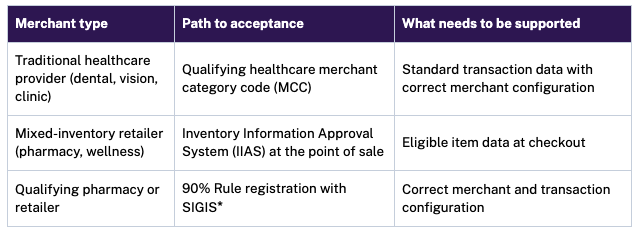
*https://sig-is.org/resources/faq/programs/90-registration
When those requirements are not supported by the payment flow, an otherwise valid HSA or FSA payment can run into unnecessary friction or be declined.
For your customers, that can mean another payment to explain or reprocess. For your platform, it can mean support requests, a less seamless checkout experience and eligible payment volume that moves to another method.
The challenge is not that your software team needs to become an expert in HSA and FSA rules. The challenge is making sure the payments infrastructure behind your platform knows how to handle them.
HSA and FSA Support Shouldn’t Become a Development Project
Building that capability independently can pull a SaaS team into healthcare-specific payments requirements that sit well outside its core product.
Different merchant types may need different approaches to HSA and FSA acceptance. A traditional healthcare provider may qualify based on its MCC. A merchant outside standard healthcare categories may use an IIAS to identify eligible products or services. Other qualifying merchants may operate under the 90% Rule.
The payment flow also needs to support the right merchant configuration and transaction data so that information reaches the processor correctly.
For a platform, that creates a build-versus-add decision. You can invest engineering resources in understanding and maintaining the healthcare-specific payments layer yourself, or work with a payments partner that already supports it.
Add HSA and FSA Payments. Don’t Rebuild Your Product.
NMI helps software platforms add payments capabilities, including HSA and FSA support, without building payments infrastructure or healthcare-specific requirements from scratch.
For supported merchants, we can pass the healthcare-specific information required for eligible HSA and FSA transactions, supporting traditional healthcare MCCs, merchants using an IIAS and qualifying 90% Rule configurations.
If your customers already use an IIAS, we can work with the eligibility data it provides rather than requiring them to replace it.
And because healthcare commerce does not happen in only one channel, we support eligible HSA and FSA transactions both online and in person, on supported processor connections, through our API and Cloud payment flows.
That means a SaaS platform serving a dental practice, specialty pharmacy, wellness business or other healthcare-focused customer can extend its payments capabilities without turning HSA and FSA processing into a standalone development project.
Your team stays focused on your product. Your customers get another way to serve theirs.
What HSA and FSA Support Can Add to Your Platform
- Fewer declined transactions your customers have to explain
- A better checkout experience your customers credit to your platform
- More processed volume that used to walk out the door
- A capability your competitors’ customers already expect, delivered without a major development project
For your customers, HSA and FSA acceptance is about giving consumers a better way to pay for eligible healthcare expenses. For your platform, it can be much more than that. It is an opportunity to add value to your product, deepen your payments offering and better serve the verticals you already support.
For a closer look at how this plays out at the merchant level, read Offering Your Merchants Better Ways To Process HSA and FSA Transactions.
Ready to see what turnkey HSA and FSA processing does for your approval rates and your revenue on eligible transactions? Reach out to a member of our team today.