


Payments fraud is an expensive problem, and attacks are increasing and becoming more sophisticated. So surely merchants are adopting the latest artificial intelligence (AI) and machine learning (ML) fraud prevention tools with open arms, right? Not quite. Data from the Merchant Risk Council (MRC) and Visa’s 2026 Global eCommerce Payments and Fraud Report shows adoption of AI and ML-powered fraud tools is slipping. For ISOs, software companies and payment providers, that gap represents a real opportunity to give merchants the education, technology and support they need to reduce losses from fraud without adding more work or complexity.
Payments Fraud Is a Growing Problem for Your Merchants
Small merchants lost 3.4% of their revenue to payments fraud in 2025, according to MRC/Visa. Mid-market businesses fared even worse at 4.5%, up 40% year-over-year. And direct losses are just the start. LexisNexis reports that every dollar lost to fraud ends up costing retail and eCommerce merchants in the United States $4.61 when additional expenses such as investigation, administration and customer recovery are included.
Why the surge? Fraudsters are becoming more effective. AI tools and fraud-as-a-service are making attacks cheaper, faster and easier to scale. They can help criminals create more convincing identities, automate attacks and rapidly test stolen payment credentials. Merchants need fraud prevention systems capable of responding at the same speed. The good news is that a new generation of AI/ML-powered fraud tools can analyse large volumes of transaction device and behavioral data in real time. The problem is, most merchants aren’t yet using them.
What the Data Says About AI and ML Adoption
MRC and Visa found that adoption of AI and ML fraud tools ranges from fewer than half of merchants down to roughly a quarter, depending on the technology. Adoption also fell across every category covered in the report, in some cases by as much as 10%.
For small merchants, low adoption of complex tools like in-house negative behavior scores is understandable. These systems can require significant data, specialist knowledge and ongoing management. What’s harder to explain is that just 37% of merchants use vendor-provided AI and ML solutions, even though these platforms can offer a simpler and faster route to next-generation fraud prevention.
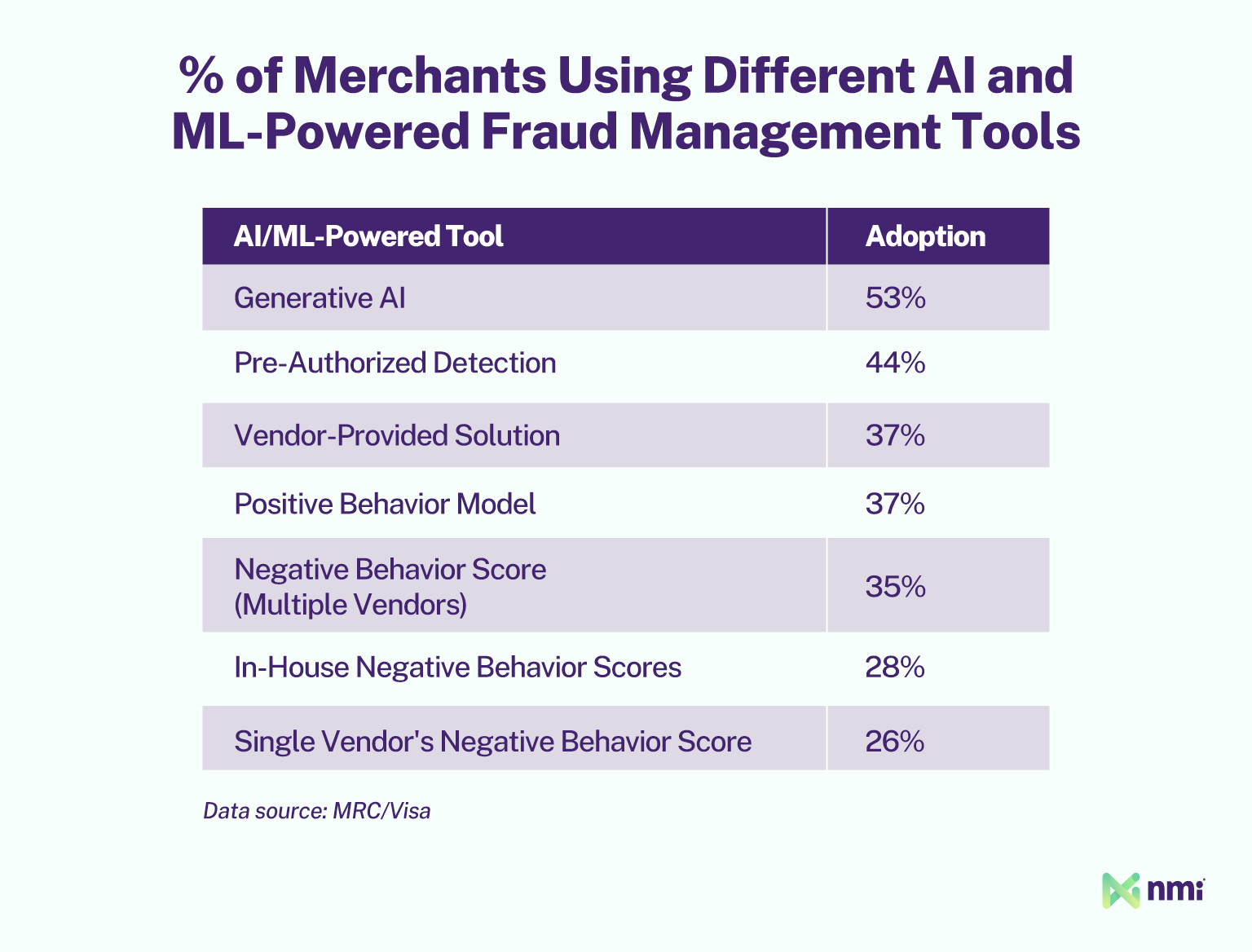
The data suggests that merchants understand the potential of AI but remain cautious about deploying it within their fraud operations. For payment providers, the challenge is not simply making more technology available. It is making that technology easier to understand, adopt and manage.
Why Are Merchants Sticking With Manual and Rules-Based Tools?
Two barriers stand out in the data: cost and complexity.
Cost pressure is climbing. The share of merchants that named minimizing operational costs as their top fraud management priority hit 29% this year, nearly three times the 2024 figure. Almost half of merchants plan to spend the same amount or less on fraud tools over the next two years. That is a sharp reversal from 2024, when most merchants planned to increase spending. To a merchant watching every dollar, sticking with simple screening rules and manual review can appear to be the more economical choice. But that calculation often overlooks the ongoing cost of investigating transactions, managing chargebacks and incorrectly declining legitimate customers.
Complexity is the other blocker. MRC and Visa found that 31% of merchants consider AI and ML accuracy a leading fraud management challenge, and 43% identified fraud orchestration, or getting all of their tools working together, as a top area for improvement. When merchants are already struggling to manage the tools they have, adding new and more complex ones is a tough sell.
Integrated Platforms Answer Both Objections
This is where integrated fraud management platforms can help. Rather than requiring merchants to assemble and maintain a collection of separate tools, an integrated platform brings multiple fraud capabilities together in one service. This can reduce the work required to connect systems, interpret different scores and manage overlapping fraud rules. It also reduces reliance on slow, error-prone manual reviews. That matters, because making fraud management less time consuming is a priority for 62% of merchants, according to MRC and Visa.
Under the hood, these platforms combine several of the advanced fraud prevention capabilities, including:
- Supervised machine learning that scores the risk of every transaction in real time using historical data
- Unsupervised machine learning that analyzes behavior and detects emerging fraud patterns that may not match known attacks
- Device and contextual intelligence that considers signals such as device identity, location and transaction behavior
- Real-time risk scoring that brings multiple fraud signals together to assess each transaction
- Automated decision support that helps merchants approve, decline or review transactions based on their own fraud and business policies
- Self-optimizing models that automatically improve with every transaction across the network
- Behavioral and contextual signals, like device fingerprinting and behavioral biometrics, that separate good users from bad, even against identity spoofing
- Holistic risk scoring that turns every signal into one automated approve, decline or review decision, reducing false positives
For merchants, the value is not the number of models running behind the scenes. it is the ability to make better decisions more quickly, reduce manual work and stop more fraudulent transactions without creating unnecessary friction for legitimate customers.
The Opportunity to Serve an Immediate Merchant Need
Between 21% and 28% of merchants told MRC and Visa they plan to start using the AI and ML tools covered in the report within the next 12 months. In other words, your merchants already know they need to strengthen their approach to fraud prevention. Many simply lack the time, expertise or budget to build and manage a sophisticated fraud stack themselves. They just need a partner to make it easy, and that’s where you come in. By offering fraud prevention through the payment systems and services merchants already use, you can make AI and ML powered fraud protection easier to access while creating a valuable new service for their portfolios.
As an NMI partner, you have access to Advanced Fraud Protection powered by Kount 360, a comprehensive fraud management platform that brings AI-powered fraud detection, device intelligence, risk scoring and configurable policies together within one service. For many merchants, getting started is as simple as enabling Kount Fraud Manager through their account dashboard. And if you serve complex or enterprise merchants that need custom integrations, we support that too.
Advanced Fraud Protection helps you offer merchants more advanced fraud protection without asking them to build, connect and maintain a collection of separate tools. It gives them a practical way to make decisions in real time, reduce manual reviews and respond as fraud tactics evolve.
To learn how Advanced Fraud Protection can give your merchants cutting-edge fraud protection without adding unnecessary cost or complexity, reach out to our team today.