

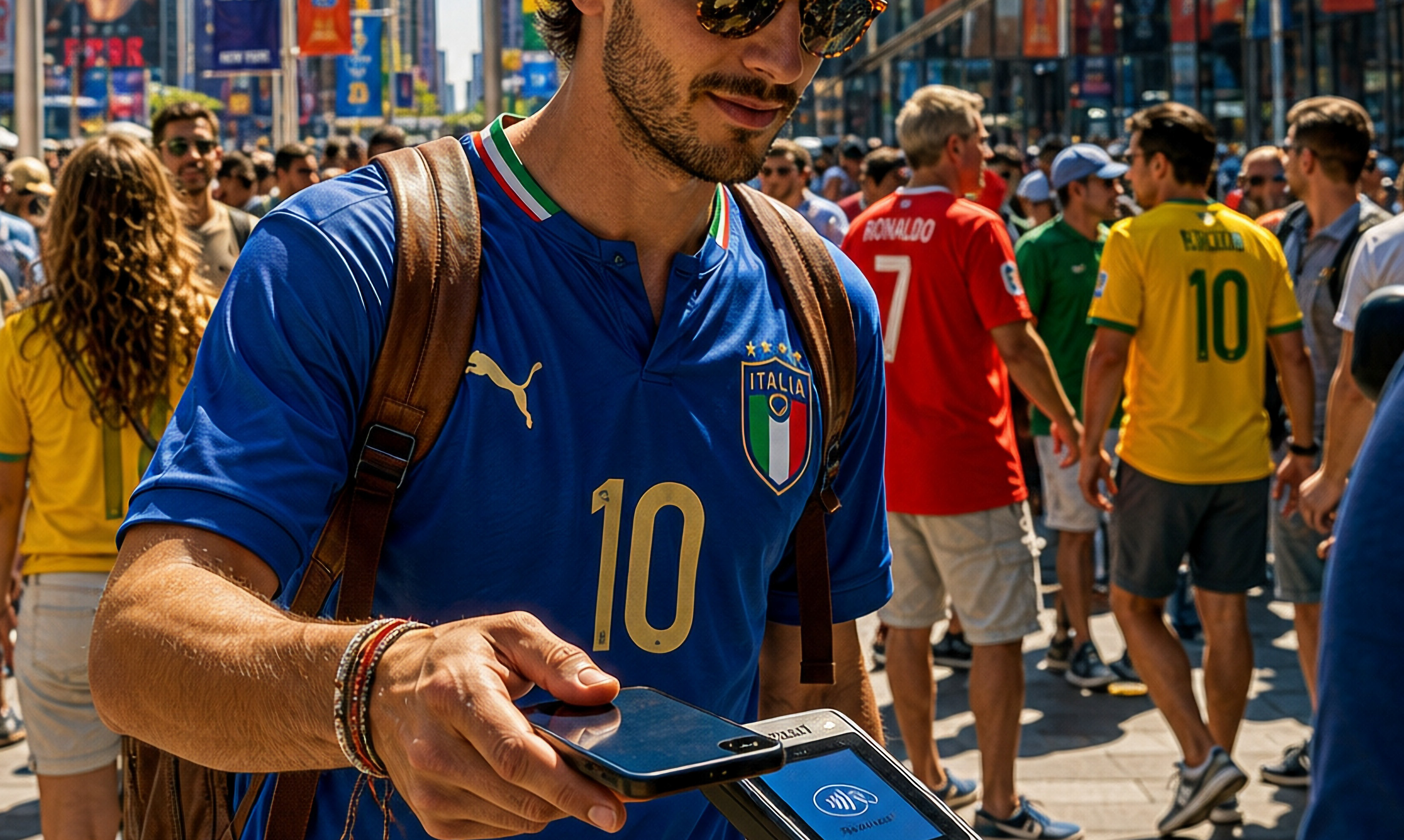
The FIFA World Cup 26™ is not a future stress test for U.S. payment infrastructure – it’s a live one. And for cities already counting down to something bigger, the data from week one carries extra weight. Los Angeles is hosting eight World Cup matches this summer at SoFi Stadium. In two years, it hosts the 2028 Summer Olympics. The U.S. will then follow that with the 2034 Winter Games in Salt Lake City. What this year’s World Cup reveals about payment readiness is a preview of what the U.S. will need to get right on the world’s biggest sports stages, repeatedly, for the rest of the decade.
So what is the data saying? To get a clean read on visitor spending behavior, we looked at the card-present transactions processed through NMI’s platform* across merchants in the United States, Canada and Mexico for the first week of the tournament (June 11–16), and compared that week to the five weeks before kickoff. Card-present activity is the sharpest lens for this: it captures the moment a fan is physically in a city, at a transit gate, a parking meter, a stadium kiosk or a local restaurant, and chooses how to pay. What we found was a clear split. Transactions on foreign-issued cards were up 24%. Domestic spend barely moved, up just 1.4%. The gap between those two numbers is the fingerprint of millions of international fans arriving in host cities, reaching into their pockets and finding out whether the U.S. is as easy to pay in as the countries they came from.
They Arrived Ready to Tap
One of the clearest signals from week one is how international visitors pay. Around 84% of foreign-issued card transactions were contactless in person. U.S.-issued cards ran at 67%. France stood out at 97% contactless, well ahead of the European average of around 86%.
This is not a marginal difference. It reflects how normalized tap-to-pay has become in the countries sending the most fans to North America this summer. When those visitors reach a U.S. kiosk, transit gate or stadium concession stand that does not accept contactless, that gap becomes friction.
The country-level breakdown tells the story of who has arrived:
- Germany: +139%
- Netherlands: +131%
- Japan: +119%
- Peru: +87%
- Argentina: +53%
- China: +51%
- Mexico: +34%
- Colombia: +32%
- Austria: +30%
- Spain: +27%
By sheer volume, the largest visiting card bases were Mexico, France, the United Kingdom, Japan and Canada. France and the UK are not in the top gainers because they compare against already-high year-round baselines: the UK rose around 15% and France around 8%. They remain among the largest international cohorts in absolute terms, just not the fastest-moving relative to where they started.
NMI research conducted ahead of the tournament found that 46% of U.S. travelers who have traveled internationally in the last year say payment experiences abroad are faster or easier than in the U.S. Those travelers’ expectations now have a counterpart: millions of international visitors arriving here and bringing their own benchmark with them.
The same expectation gap will apply in 2028, at an even greater scale. The International Olympic Committee estimates the Los Angeles Games will draw 15,000 athletes from over 200 countries and millions of international spectators.
Transit Took the First Test
The biggest single category for international card spend in week one was local commuter transit and ferries, up 38% week over week. Car rental was up 26%, parking up 18%. Visitors are moving through host cities, and how they pay at each step shapes the experience.
Before the tournament started, NMI surveyed 1,009 U.S. adults who had traveled internationally in the last year. Transit came back as the clearest weak spot in U.S. payment readiness. Seventy-seven percent said difficulty paying for transportation would negatively affect visitors’ overall experience of the U.S. Eighty-one percent agreed that easy transportation payments would help visitors spend more time and money around a city.
The tournament is now providing the real-world test of those attitudes.
Los Angeles is already drawing the right lesson. LA Metro has publicly framed the World Cup as a rehearsal for the 2028 Olympics, investing in tap-to-pay fare infrastructure and planning for a transit-first Games. The authority is deploying contactless payment acceptance across its network, allowing riders to tap a credit or debit card, mobile wallet or smartwatch at faregates and bus validators, without a separate app or transit card. The upgrade is aimed at meeting the expectations of an international audience that is already accustomed to this experience in London, Tokyo, Paris and Sydney.
NMI helps power contactless fare payments across cities including Atlanta and Houston, two of the World Cup host destinations. The infrastructure allows fans arriving from anywhere in the world to move through those cities using the same tap they use at home. For a visitor arriving from Berlin or Tokyo, that frictionless moment is not remarkable. The absence of it would be.
The lesson for LA28 is direct. Cities that close the contactless transit gap will be better positioned for the Olympics. Cities that do not will face that test in front of a larger audience, with less time to prepare.
What the Data Is Telling the Industry
The week one numbers confirm that the demand is here, and it is behaving exactly as forecast. Eighty percent of consumers surveyed by NMI said easy payment options make them more likely to make a purchase while attending an event. Seventy-five percent said long payment lines make them less likely to buy. Eighty-five percent agreed that easy and quick payments are important to the U.S. economy at a time when tourism is growing.
The economic opportunity is not abstract. It is measured in the gap between what visitors intend to spend and what they actually spend when payment friction gets in the way.
For the U.S., the World Cup, the 2028 Olympics and the 2034 Winter Games represent something beyond a sequence of sporting events. They are a concentrated window in which the country’s payment infrastructure will be evaluated, repeatedly, by the most internationally diverse audiences it has ever hosted. The contactless gap visible in week one data, the transit friction identified in consumer research, these are not isolated issues. They are consistent patterns, and the time to address them is now, while there is still runway.
What Comes Next
The first week of the FIFA World Cup is already showing how major international events can change payment behavior. Foreign-issued card activity is up. Transit and travel categories are moving. Contactless rates are high. Visitors are paying in person, and they are tapping.
For the payments industry, this is a useful test. Not because everything has to change overnight, but because events like this reveal where expectations are moving fastest.
The same lessons will matter well beyond this tournament. As North America continues to host major global events, including LA28, payment experiences will play a bigger role in how visitors judge cities, venues, transportation systems and local businesses.
At NMI, we help partners deliver payment experiences across attended and unattended environments, including transportation, parking, vending, retail, hospitality and events. The early World Cup data reinforces what we already see every day: payments are no longer just a back-office function. They are part of the customer experience.
And when the world shows up, that experience needs to work.
* Data is based on card-present transactions processed through the NMI Gateway by merchants in the U.S., Canada and Mexico. Week one covers June 11–16, compared to a daily average baseline of May 4–June 10.
