




- What Are Interchange Fees?
- Why Interchange Matters for Merchant Pricing
- How Interchange Fees Work in a Card Transaction
- How Much Do Interchange Fees Cost?
- How Interchange Fees Are Calculated
- Interchange Fees by Card Network
- Interchange Fees vs. Other Card Processing Fees
- Interchange Pricing Models
- How to Reduce Interchange Fees
- Interchange Fee Regulation in the United States
- Where to Find Current Interchange Rate Schedules
- Take Control of Your Interchange Costs
- Frequently Asked Questions About Interchange Fees
Interchange fees are the transaction costs a merchant’s bank pays to a cardholder’s bank every time someone swipes, taps or enters their card details. For credit cards in the U.S., these fees typically range from roughly 1.4% to 2.5% of the transaction amount plus a fixed per-transaction fee, though qualifying programs can run lower and downgraded transactions higher. Some markets cap these fees by regulation. Domestic U.K. and intra-European Economic Area consumer transactions are generally capped at 0.3% for credit and 0.2% for debit, though cross-border rates between the two regions run considerably higher. Either way, interchange is the largest component of card processing costs for most businesses.
For software platforms and payment partners, interchange represents the baseline cost underneath any pricing model you ultimately pass on to merchants. This guide breaks down how interchange works, what determines the rates and how to reduce what you pay.
What Are Interchange Fees?
Interchange fees are the transaction costs that a merchant’s bank pays to a cardholder’s bank every time a card payment is processed. The cardholder’s bank (called the issuer) receives the fee as compensation for its role in the transaction, including taking on credit and fraud risk, and processing the payment. In the U.S., credit card interchange typically runs roughly 1.4% to 2.5% of the transaction amount plus a fixed per-transaction fee, though the exact rate depends on several factors.
Every other fee, including processor markup, gateway charges and assessment fees, gets layered on top of this baseline. So when you’re building out your payment economics, interchange is where the math starts.
Why Interchange Matters for Merchant Pricing
If you’re embedding payments into your software or managing a merchant portfolio, interchange has a direct line to your margins. Say your platform processes $50 million in annual card volume. A 1 percentage-point reduction in effective interchange would be worth about $500,000 a year. That kind of shift usually comes from a combination of things: qualifying more transactions, submitting enhanced data where eligible or correcting a misclassified MCC. That money either strengthens your take rate or lowers what your merchants pay, depending on how you structure your pricing.
Understanding how interchange actually works lets you find that point, spot optimization opportunities and choose the pricing model that fits your business. For a deeper look at pricing structures, see our guide to payment pricing and fees.
How Interchange Fees Work in a Card Transaction
The flow of an interchange fee follows a specific path through the payment ecosystem. Let’s walk through it step by step.
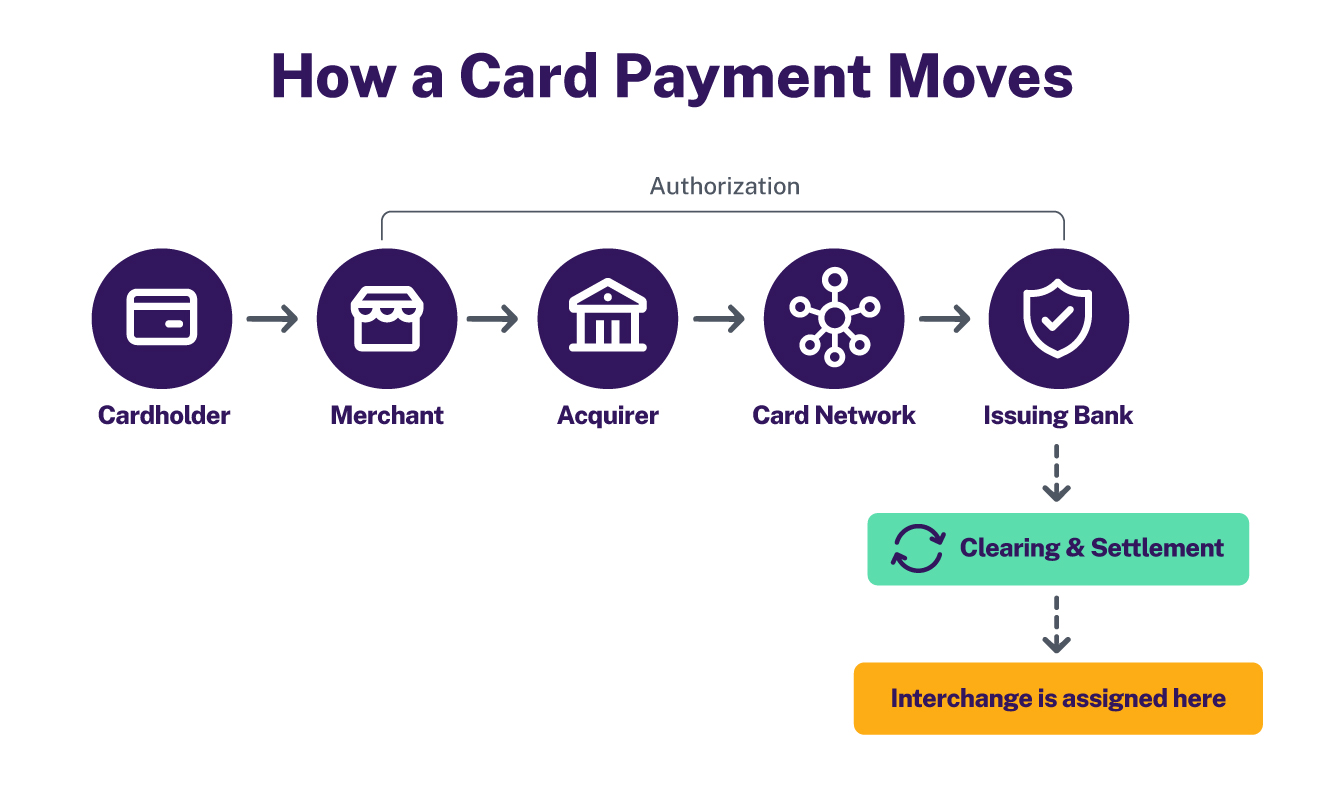 How interchange moves through a card transaction, from authorization to clearing
1. The cardholder initiates a purchase
A customer swipes, taps or enters card details online. This action kicks off the authorization process.
2. The acquirer routes the transaction
The merchant’s bank (or the payment processor acting on the merchant’s behalf) sends the transaction request through the appropriate card network, such as Visa, Mastercard, Discover or American Express.
3. The card network routes the request to the issuer
The network passes the authorization request to the cardholder’s bank. The interchange category is determined later, at clearing, based on published rate tables and qualification criteria. The rate tables account for card type, merchant category, transaction method and other variables we’ll cover below.
4. The issuing bank approves or declines the transaction
The cardholder’s bank receives the authorization request and approves or declines the transaction. At this stage the issuer is authorizing the payment rather than receiving the interchange fee.
5. The transaction clears and settles
After authorization, the transaction moves through clearing and settlement. This is when the network assigns the interchange category and the financial amounts are calculated and settled between participants, including the interchange payable by the acquirer to the issuer. The merchant is then funded according to the arrangements it has with its acquirer or payment provider. The entire process typically completes within one to two business days.
How Much Do Interchange Fees Cost?
Interchange costs vary depending on whether you’re processing credit or debit transactions. For debit, the rate also depends on whether the issuing bank falls under federal regulation.
Typical Card Processing Costs
A quick comparison of common card-type pricing
-
Credit Cards
1.4%–2.5% + fixed fee
of each transaction
Usually the highest-cost card type
-
Regulated Debit
$0.21 + 0.05%
plus up to $0.01 fraud adjustment
Issuers with $10 billion or more in assets
-
Unregulated Debit
Varies
Falls between credit and regulated debit
Issuers under $10 billion in assets
For regulated debit cards, the Federal Reserve’s Regulation II caps interchange at $0.21 plus 0.05% of the transaction value. Issuers meeting fraud-prevention standards can add up to $0.01 more. This cap generally applies to debit card issuers with $10 billion or more in assets.
Smaller issuers are exempt from the cap. Their debit interchange rates can be higher, though still typically lower than credit card rates.
How Interchange Fees Are Calculated
Several factors determine the exact interchange rate for any given transaction.
Card type and reward tier
Premium rewards cards carry higher interchange than standard cards. A basic Visa card might qualify for a lower rate than a Visa Signature card with travel rewards. Interchange revenue can help support the costs associated with issuing cards and providing cardholder benefits, so premium cards can carry higher interchange rates.
Card present vs. card not present
In-person transactions where the physical card is present often qualify for lower rates than ecommerce or phone orders. The fraud risk is lower when you can verify the card and cardholder are actually there, so the networks reward that with better pricing. Card-not-present transactions generally carry different risk and qualification criteria, which can result in higher interchange for some transaction types.
Merchant category code
Every business is assigned a merchant category code (MCC) that influences interchange. Some industries have specific or preferential interchange rates:
- Grocery stores and supermarkets
- Gas stations and fuel merchants
- Utilities and government services
Other categories may face different or higher costs, based on the applicable network programs and transaction characteristics.
Ticket size and transaction volume
Ticket size can affect the overall interchange cost because many rates combine a percentage with a fixed per-transaction amount. Some networks and interchange programs also use transaction volume or merchant sales volume as part of their qualification criteria.
Data quality and security signals
The information submitted with a transaction can affect which interchange category it qualifies for. For B2B and government card transactions, submitting enhanced data can help eligible transactions qualify for lower interchange categories. Note that the programs differ by network. Visa has replaced its Level 2, Level 3 and Large Ticket (Non-GSA) programs with the Commercial Enhanced Data Program (CEDP), while other networks still operate on Level II and Level III structures.
AVS (Address Verification Service) and CVV verify payment details and reduce fraud risk. Passing them won’t lower interchange on its own, but failing them can cause downgrades on transaction types where the network requires them. Learn more about Level 2 and Level 3 payments.
Interchange Fees by Card Network
Each major card network sets its own qualification criteria. Visa and Mastercard publish interchange schedules that update roughly twice per year, in April and October, and Discover provides acquirer interchange pricing. Navigating those schedules takes patience given the hundreds of rate categories.
American Express works differently. It has historically set its own merchant discount rate rather than using interchange, and under the U.S. OptBlue program the provider sets the merchant’s American Express rate. So while the economics land in a similar place, it isn’t the same rate-table model Visa and Mastercard use.
Interchange Fees vs. Other Card Processing Fees
Interchange is only one component of your total processing cost. Here’s how it fits alongside other fees.
Interchange is the base cost. Assessments, processor markup and gateway fees layer on top.
Assessment fees
Assessment fees are paid directly to the card networks on each transaction. They typically run around 0.13% to 0.15%, are non-negotiable and vary by network, transaction type and program. They’re generally much smaller than interchange.
Processor markup
The processor markup is the margin your payment processor or gateway adds on top of interchange and assessments. Unlike interchange, processor markup is negotiable and varies widely between providers.
Gateway and ancillary fees
Additional charges for gateway access, PCI compliance, chargebacks and batch processing fall into this category. The amounts vary depending on your provider and pricing structure.
When evaluating total processing costs, ask your provider to break out interchange, assessments and markup separately. This transparency helps you understand where your money actually goes.
Interchange Pricing Models
The way interchange gets passed through to merchants depends on the pricing model in use. With interchange-plus pricing, merchants see the actual interchange cost plus a fixed markup. This provides full transparency into what they’re paying and why.
Other models, like blended or tiered pricing, bundle interchange into flat rates that can obscure the underlying costs. Interchange-plus doesn’t necessarily mean lower processing costs, but the added visibility can make it easier to understand what’s driving them. For a complete comparison of pricing approaches, visit our payment pricing and fees guide.
How to Reduce Interchange Fees
While interchange rates are set by the card networks, several approaches can help you qualify for lower rate categories where the network’s criteria allow it.
Submit Enhanced Transaction Data
For B2B and government card transactions, providing enhanced data, like tax amounts, customer codes and line-item details, can help eligible transactions qualify for lower interchange. Savings vary by card type and transaction, but qualifying B2B and B2G purchases can see a real reduction per transaction.
The requirements have tightened. Visa’s CEDP now validates submitted data and grants reduced rates only to merchants it verifies, so incomplete or placeholder data no longer qualifies. Check our CEDP guide for the current Visa requirements and our Level 2 and Level 3 guide for the broader fundamentals.
Use network tokens and tokenization
Network tokens improve authorization rates and help keep stored payment credentials current when cards expire or are replaced, reducing avoidable declines. Depending on the card network, transaction type and applicable program, tokenized transactions may also receive different interchange treatment, but tokenization does not automatically reduce interchange on every transaction. Learn more about how network tokens work.
Submit complete and accurate transaction data
Missing or incorrect transaction data can prevent a payment from meeting the criteria for its most appropriate interchange category. Address Verification Service (AVS) and CVV checks signal lower fraud risk to the issuing bank. On transaction types where the network requires them, failing these checks can push a transaction into a higher interchange category.
Confirm the correct merchant category code
An incorrect MCC can push transactions into higher interchange tiers. A merchant’s MCC should accurately reflect its primary business activity, so correcting a genuine misclassification can help ensure transactions are assessed under the appropriate interchange categories.
Move to interchange-plus pricing
Moving to interchange-plus pricing doesn’t reduce the interchange rate itself. What it does is separate interchange from processor markup, making it easier to identify where costs originate and where genuine optimization opportunities may exist.
Interchange Fee Regulation in the United States
Regulation differs between credit and debit cards.
Credit card interchange fees
Unlike regulated debit transactions, U.S. credit card interchange is not subject to an equivalent Regulation II federal cap. Rates are set by the card networks and vary widely, generally falling in the 1.4% to 2.5% range depending on card type and transaction characteristics.
A proposed antitrust settlement, preliminarily approved in June 2026, would introduce contractual reductions and caps on certain Visa and Mastercard credit interchange rates if it receives final court approval.
Debit card interchange fees and the Durbin Amendment
The Durbin Amendment, passed as part of the 2010 Dodd-Frank Act, directed the Federal Reserve to cap debit interchange for large issuers. Under Regulation II, banks with $10 billion or more in assets are limited to $0.21 plus 0.05% of the transaction value, with an additional $0.01 available for qualifying fraud-prevention programs.
Smaller issuers, those under the $10 billion threshold, are exempt from the cap and can charge higher debit interchange rates.
Where to Find Current Interchange Rate Schedules
Visa and Mastercard publish their interchange tables directly on their websites, updated on the same twice-yearly cycle covered above.
For payment partners managing diverse merchant portfolios, visibility into transaction data, processor connections and available routing options can make it easier to understand and manage payment costs. A processor-agnostic gateway helps track and optimize routing across networks as those schedules change. The ability to route transactions intelligently becomes increasingly valuable as interchange complexity grows.
Take Control of Your Interchange Costs
Understanding interchange is the first step toward optimizing your payment economics. At NMI, our platform supports Level II and Level III data submission, network tokenization and interchange-plus pricing visibility. These capabilities can help identify qualification opportunities, improve cost visibility, reduce payment costs where eligible and help improve margins.
Whether you’re a software company embedding payments or a payment partner managing merchant relationships, we can help you build a more profitable payments business.
Talk to our team to learn how we can support your interchange optimization.
Frequently Asked Questions About Interchange Fees
Who ultimately pays interchange fees?
Technically, the acquirer pays interchange to the issuer. In practice, merchants typically bear the cost through the card processing fees they pay their acquirer or payment provider. Some merchants pass this expense to consumers through higher prices or, where permitted by applicable law and card network rules, through credit card surcharges.
Are interchange fees the same as swipe fees?
“Swipe fee” is an informal term used inconsistently. It often refers to interchange specifically, and most news coverage uses it that way. It’s also used more loosely for total card acceptance costs, which include interchange plus assessment fees and processor markup. It’s worth clarifying which one someone means before comparing numbers.
How do banks make money from interchange fees?
Issuing banks receive interchange revenue as compensation for their role in card transactions. That revenue can help cover costs including transaction processing, fraud and cardholder rewards programs.
Do interchange fees apply to ACH payments?
No. Interchange is specific to card networks like Visa and Mastercard. ACH transactions carry separate, typically lower, per-transaction fees that don’t involve interchange.
Is it legal to charge customers a fee for using a debit card?
In the U.S., Visa and Mastercard rules prohibit merchants from applying surcharges to debit card transactions, including when a debit card is processed without a PIN. Credit card surcharges may be permitted subject to card network requirements and vary by state and federal law. Merchants should always check the current rules and legal requirements before implementing a surcharge program.
Don’t just turn on payments, transform the way you do business
- Generate New Revenue By adding or expanding payment offerings to your solution, you can start earning higher monthly and transaction-based recurring revenue.
- Offer the Power of Choice Allow merchants to choose from 125+ shopping cart integrations and 150+ processor connections to streamline their onboarding.
- Seamless White Labeling Make the platform an extension of your brand by adding your logo, colors and customizing your URL.